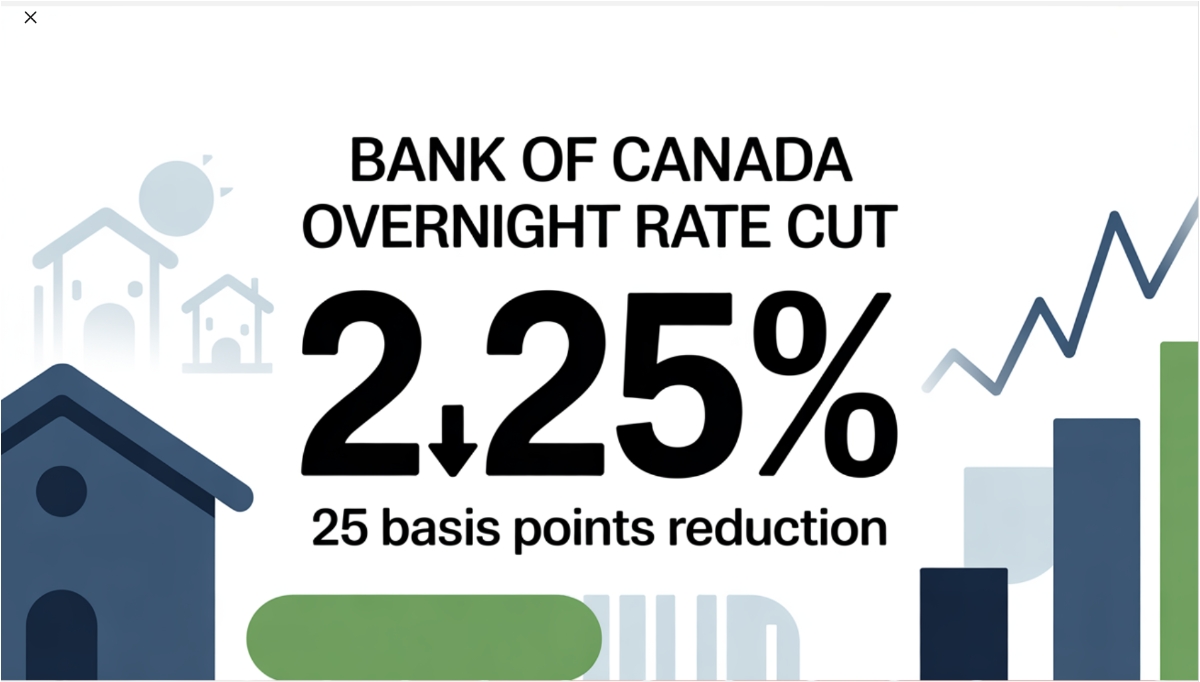
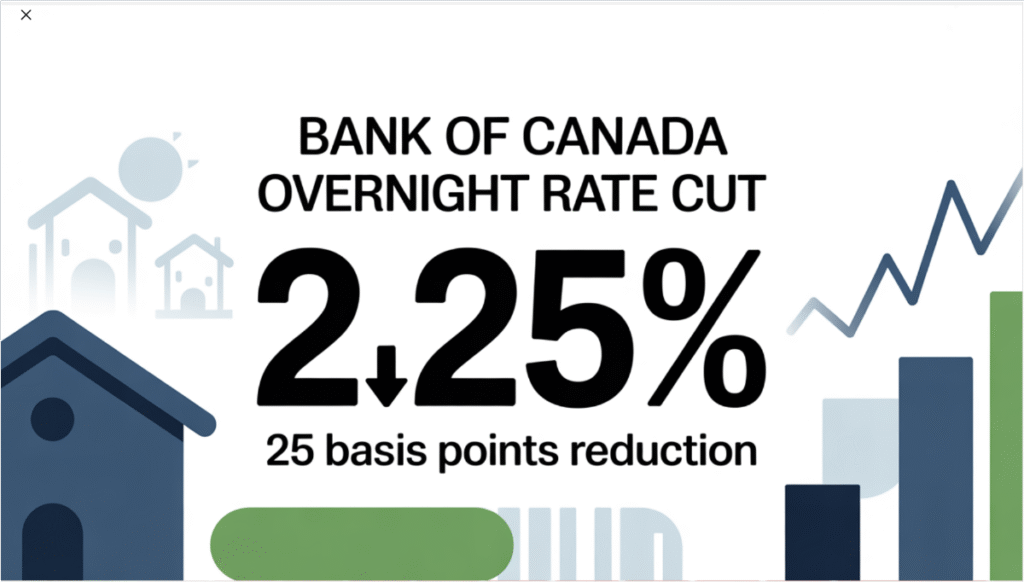
Today, the Bank of Canada lowered the overnight policy rate by 25 bps to 2.25% as was widely expected. This is the bottom of the Bank’s estimate of the neutral overnight rate, where monetary policy is neither expansionary nor contractionary. The economy will grow at about a 0.5% pace in Q3, causing the Bank to cut rates again at the final meeting this year on December 10. The easing will then end, but rates will remain relatively subdued until more trade uncertainty is alleviated.
The Fed is widely expected to cut rates by 25 bps this afternoon as well.
Today’s Monetary Policy Report suggests that the significant decline in export growth will persist for some time. Layoffs in trade-dependent sectors have already slowed considerably, especially in Ontario, Quebec, and some softwood lumber businesses in several provinces. The central bank acknowledged that “because US trade policy remains unpredictable and uncertainty is still higher than usual, this projection is subject to a wider-than-normal range of risks.”
“In the United States, economic activity has been strong, supported by the boom in AI investment. At the same time, employment growth has slowed and tariffs have started to push up consumer prices. Growth in the euro area is decelerating due to weaker exports and slowing domestic demand. In China, lower exports to the United States have been offset by higher exports to other countries, but business investment has weakened. Global financial conditions have eased further since July and oil prices have been fairly stable. The Canadian dollar has depreciated slightly against the US dollar.”
“Canada’s economy contracted by 1.6% in the second quarter, reflecting a drop in exports and weak business investment amid heightened uncertainty. Meanwhile, household spending grew at a healthy pace. US trade actions and related uncertainty are having severe effects on targeted sectors, including autos, steel, aluminum, and lumber. As a result, GDP growth is expected to be weak in the second half of the year. Growth will get some support from rising consumer and government spending and residential investment, and then pick up gradually as exports and business investment begin to recover.”
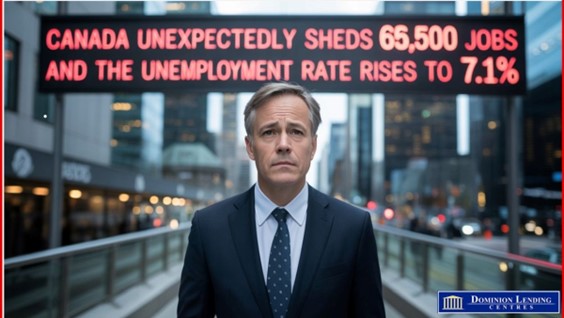
Canada’s labour market remains soft, and job vacancies have declined sharply despite the September improvement in job growth. Job losses continue to mount in trade-impacted sectors, and hiring has been weak across the economy. The unemployment rate remained at 7.1%, well above the US rate of 4.3%. Slower population growth translates into fewer new jobs and less inflation pressure. On a per capita basis, the economy is already in a recession.
The Bank projects GDP will grow by 1.2% in 2025, 1.1% in 2026 and 1.6% in 2027. Quarterly, growth strengthens in 2026 after a weak second half of this year. Excess capacity in the economy is expected to persist and be gradually absorbed.
“CPI inflation was 2.4% in September, slightly higher than the Bank had anticipated. Inflation excluding taxes was 2.9%. The Bank’s preferred measures of core inflation have been sticky around 3%. Expanding the range of indicators to include alternative measures of core inflation and the distribution of price changes among CPI components suggests underlying inflation remains around 2.5%. The Bank expects inflationary pressures to ease in the months ahead and CPI inflation to remain near 2% over the projection horizon”.
“If inflation and economic activity evolve broadly in line with the October projection, the Governing Council sees the current policy rate at about the right level to keep inflation close to 2% while helping the economy through this period of structural adjustment. If the outlook changes, we are prepared to respond. Governing Council will be assessing incoming data carefully relative to the Bank’s forecast.”
Bottom Line
The Bank of Canada has shown its willingness to bolster the Canadian economy amid unprecedented trade uncertainty. While Canada is working hard to establish alternate trade partners, even China cannot replace the US in terms of proximity and cost-effectiveness, given the huge transport costs. China has stepped up its oil purchases to record levels, but larger oil flows east will require additional pipelines to BC. There is no market the size of the US market to replace exports of steel and aluminum. The US will also suffer from the economic impact of stepping away from the Canada-US-Mexico free trade deal. A renegotiation of the contract is likely to come before the end of next year. As of now, the US is signalling their desire to exit the agreement. We can only hope that cooler heads will prevail.
The auto industry is a case in point. Onshoring non-US auto production would require a 75% increase in US production and the construction of $50 billion in new factories. This would take years and significantly reduce the profitability of US auto companies.
Canada is the US’s number one supplier of steel and aluminum, with its competitively low hydroelectric costs. It will take time for the US to create the capacity to replace aluminum imports from Quebec.
Canada is the number one trading partner for 32 American states, many of which are lobbying Washington to end this CUSMA bashing.
It will take time for Canada to adjust to this new reality, which leads us to conclude that another cut in overnight rates is probable at the next decision date on December 10.
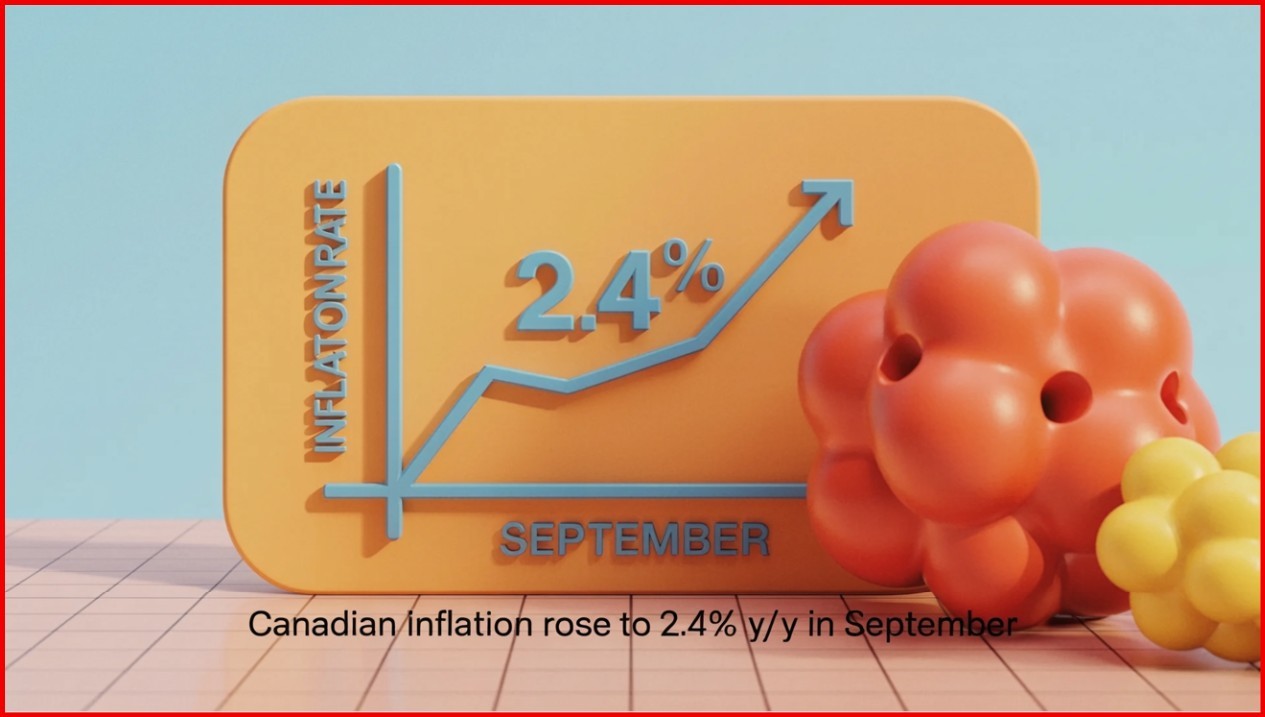
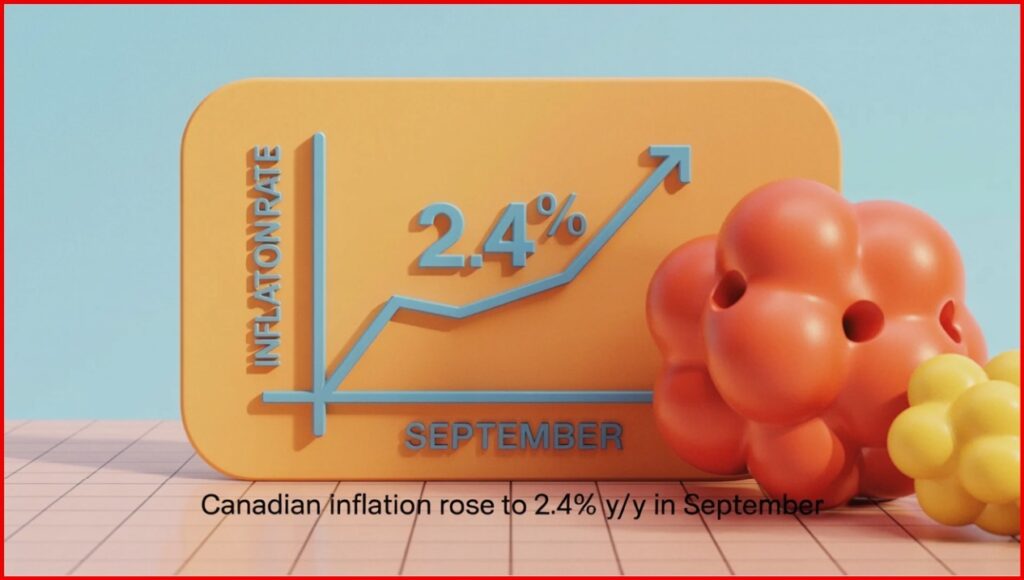
The Consumer Price Index (CPI) rose 2.4% on a year-over-year basis in September, up from a 1.9% increase in August. The acceleration in headline inflation from 1.9% in August was also larger than the median projection in a Bloomberg survey of economists, which was 2.2%.
On a year-over-year basis, gasoline prices fell less in September (-4.1%) compared with August (-12.7%) due to a base-year effect, leading to an acceleration in headline inflation. Excluding gasoline, the CPI rose 2.6% in September, after increasing 2.4% in August.
A slower year-over-year decline in prices for travel tours (-1.3%) and a larger increase in prices for food purchased from stores (+4.0%) also contributed to the upward pressure in the all-items CPI in September.
The CPI rose 0.1% month over month in September. On a seasonally adjusted monthly basis, the CPI was up 0.4%.
Gasoline prices fell 4.1% year over year in September after a 12.7% decrease in August. The smaller year-over-year decline was primarily due to a base-year effect. In September 2024, prices fell 7.1% month over month due, in part, to lower crude oil prices amid growing concerns of weaker economic growth, particularly in China and the United States. In September 2025, gasoline prices rose 1.9% monthly following refinery disruptions and maintenance in the United States and Canada, which put upward pressure on prices.
On a year-over-year basis, prices for travel tours fell 1.3% in September following a 9.3% decline in August. Despite typically declining on a month-over-month basis in September, travel tour prices rose 4.6% in the month. This was a result of higher prices for destinations in Europe and some parts of the United States, as significant events in destination cities put upward pressure on hotel prices.
Consumers paid 4.0% more year over year for food purchased from stores in September, following a 3.5% increase in August. Faster price growth was driven by increased prices for fresh vegetables (+1.9% in September, compared with -2.0% in August) and sugar and confectionery (+9.2% in September, compared with +5.8% in August).
Year-over-year grocery price inflation has generally trended upward since its most recent low in April 2024 (+1.4%). Grocery items contributing to the general acceleration included fresh or frozen beef and coffee, both due, in part, to lower supply.
Tuition fees, priced annually in September, increased 1.7% in 2025 compared with a 1.8% increase in 2024. Aside from 2019, the 2025 increase was the smallest since 1976, when the index was unchanged (0.0%).
In 2025, students from Prince Edward Island (+4.7%) experienced the largest price increase. At the same time, students from Nova Scotia (+1.1%) and Ontario (+1.1%) had the smallest increase, coinciding with a freeze on tuition fees in both provinces.
Bank of Canada Deputy Governor Rhys Mendes recently warned that traders may be putting too much emphasis on its two “preferred” core inflation measures, the so-called trim and median gauges.
In September, both CPI-median and CPI-trim came in hotter than economists were expecting. The average of these metrics was 3.15% in September, while the three-month moving average accelerated to 2.7%.
Mendes said the central bank is weighing a broader suite of gauges that suggest underlying price pressures are closer to its 2% target.
Shelter inflation rose 2.6% on an annual basis, while CPI excluding food and energy was 2.4%. CPI excluding eight volatile components and indirect taxes was 2.8%, up from 2.6%. CPI excluding taxes accelerated to 2.9% from 2.4% the previous month.
The share of components within the consumer price index basket that are rising 3% and higher — another key metric that policymakers are watching closely — declined slightly to 38%.
All 10 Canadian provinces saw prices rising at a faster year-over-year pace in September compared with August. Quebec experienced the steepest price growth, reaching 3.3% last month.
Rent prices also accelerated nationally to 4.8%, led by a 9.8% increase in Quebec. Slower rent price growth of 1.8% in British Columbia moderated the national increase, the report noted.
Bottom Line
The report shows that underlying price pressures remain elevated, raising questions about how quickly the central bank can proceed with rate cuts to aid the tariff-hit economy.
Still, the acceleration in headline and most core measures was driven by a gasoline price base-year effect — a possible reason for analysts to look through the print.
Traders in overnight swaps pared bets on a rate cut next week, lowering the odds to about 65% from close to 80% before the report. The loonie jumped to the day’s high against the US dollar. Canadian debt fell across the curve, with the two-year yield rising about three basis points to a session high at 2.38%.
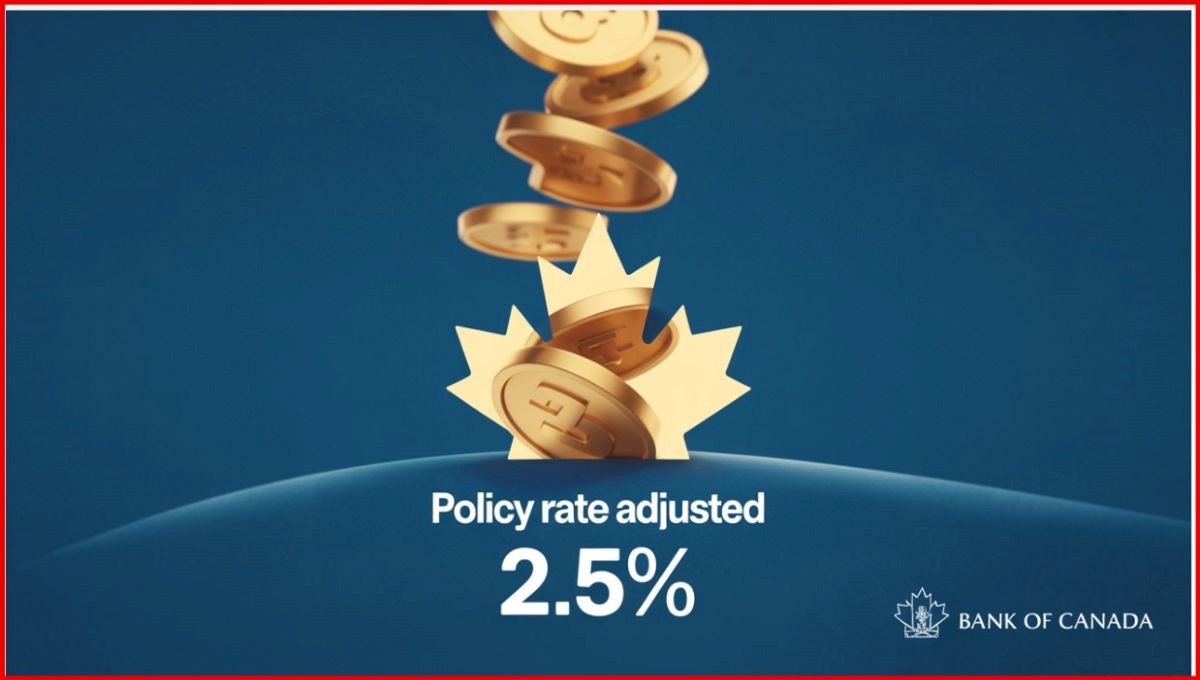
The ongoing trade war with the US drove the Bank of Canada to lower its policy rate by a quarter of a percentage point to 2.5% in September, marking the first cut in six months.
During their deliberations last month, some members of its governing council argued that more support would likely be needed given the softness in the economy, notably if the labour market weakened further.
Bank of Canada Governor Tiff Macklem recently described Canada’s labour market as “soft,” despite data showing the country added 60,400 jobs in September, which only partially reversed a decline of more than 100,000 positions over the previous two months.
The central bank will have to weigh recent economic weakness against concerns about firm core inflation over the past few months. The BoC will cut the overnight policy rate again by 25 bps to 2.25%, responding to its concern for the sectors hardest hit by tariffs, along with a housing market suffering from negative household psychology and overbuilding in the GTA and GVA.
Today’s release of the September housing data by the Canadian Real Estate Association (CREA) showed a pullback on the housing front. The number of home sales recorded through Canadian MLS® Systems declined by 1.7% on a month-over-month basis in September 2025. Nevertheless, it was the best month of September for sales since 2021.
The slight monthly decline was the result of lower sales activity in Greater Vancouver, Calgary, Edmonton, Ottawa, and Montreal, which more than offset gains in the Greater Toronto Area and Winnipeg.
“While the trend of rising sales that began earlier this year took a breather in September, activity was still running at the highest level for that month since 2021, and that was true in July and August as well, said Shaun Cathcart, CREA’s Senior Economist. “With three years of pent-up demand still out there and more normal interest rates finally here, the forecast continues to be for further upward momentum in home sales over the final quarter of the year and into 2026.”
New Listings
New supply dropped 0.8% month-over-month in September. Combined with a slightly larger decline in sales activity, the sales-to-new listings ratio eased slightly to 50.7% compared to 51.2% in August. The long-term average for the national sales-to-new listings ratio is 54.9%, with readings roughly between 45% and 65% generally consistent with balanced housing market conditions.
There were 199,772 properties listed for sale on all Canadian MLS® Systems at the end of September 2025, up 7.5% from a year earlier but very close to the long-term average for that time of the year.
“While there are more buyers in the market now than at almost any other point in the last four years, sales activity is still below average and well below where the long-term trend suggests it should be,” said Valérie Paquin, CREA Chair. “As such, we expect things to continue to pick up steadily in the future.
There were 4.4 months of inventory on a national basis at the end of September 2025, unchanged from July and August and the lowest level since January. The long-term average for this measure of market balance is five months of inventory. Based on one standard deviation above and below that long-term average, a seller’s market would be below 3.6 months, and a buyer’s market would be above 6.4 months.
Home Prices
The National Composite MLS® Home Price Index (HPI) was again almost unchanged (-0.1%) between August and September 2025. Following declines in the first quarter of the year, the national benchmark price has remained mostly stable since April.
The non-seasonally adjusted National Composite MLS® HPI was down 3.4% compared to September 2024. Based on the extent to which prices fell off beginning in the fall of 2024, look for year-over-year declines to shrink in the fourth quarter of the year.
Bottom Line
Homebuyers are responding to improving fundamentals in the Canadian housing market. Supply has risen as new listings surged until May of this year. Additionally, the national benchmark average price is 3.5% lower than it was a year earlier. That decrease was smaller than in August.
The view is nearly unanimous that the Federal Reserve will cut the overnight policy rate again by 25 basis points when it meets again on October 29.
The jury is out on the Bank of Canada’s next move. Their decision date is also October 29. While the stronger-than-expected labour market report might have dissuaded the Bank from easing, all eyes will be on the next CPI report on October 21.
With the Bank of Canada cutting the policy rate halfway through September and another 25-basis-point reduction expected by January, if not sooner, the CREA forecasts sales to rise by 7.7% in 2026.
“Interest rates were always going to be the thing that brought this thing back to life,” Cathcart said in an interview. “While that long-anticipated recovery has been delayed and dampened by trade uncertainty, the Bank of Canada is getting close to dipping out of the neutral range and into stimulative territory.
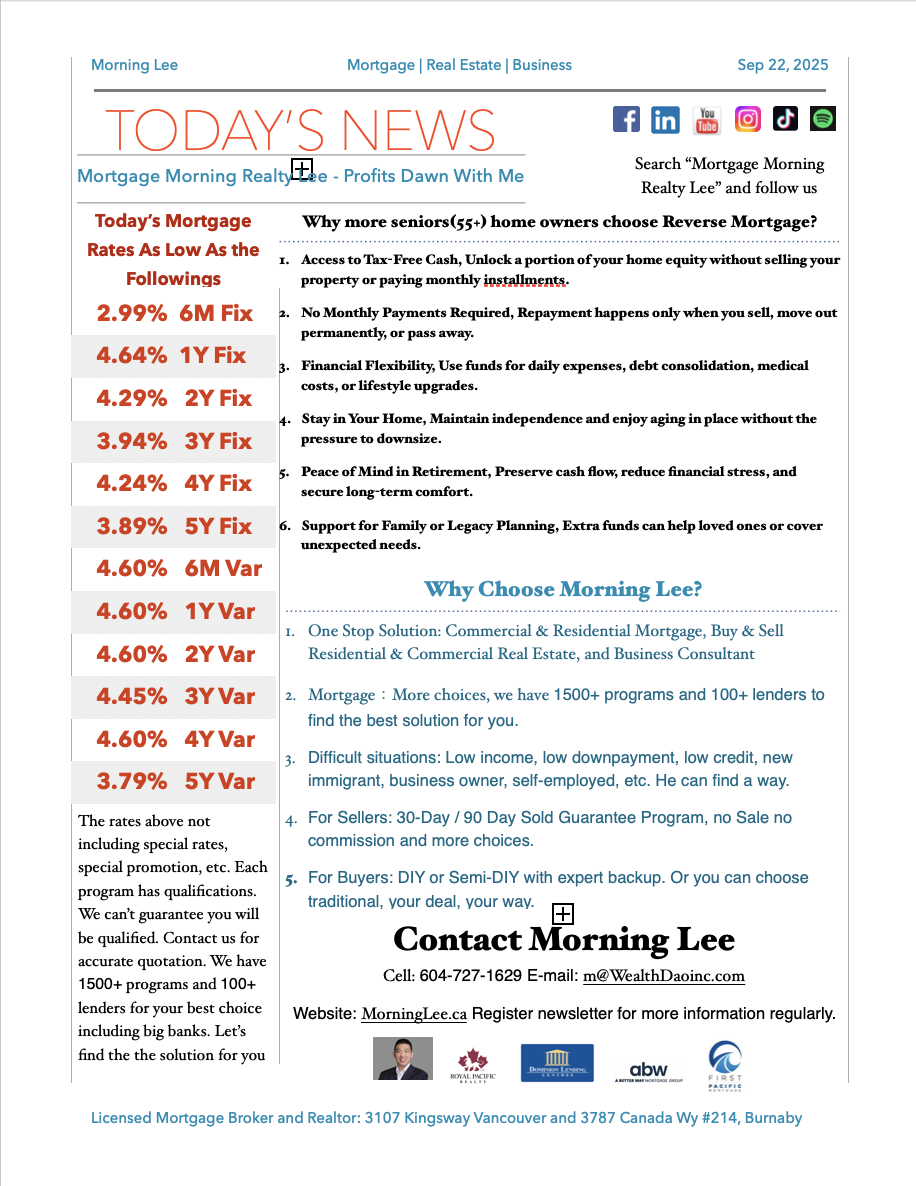
The latest Canadian mortgage rate data shows that mainstream lending products continue to trend lower, with many fixed and variable rates now entering the “3% range.” For example, the six-month fixed rate is as low as 2.99%, the three-year fixed rate stands at 3.94%, and the five-year variable rate has dropped to 3.79%. This creates a wide range of low-cost borrowing options for homeowners.
Against this shifting interest rate backdrop, reverse mortgages are seeing growing interest among homeowners aged 55 and older. This financial solution allows homeowners to convert their home equity into tax-free cash—without selling their property or being required to make monthly payments—while still retaining the right to live in their home.
As housing markets fluctuate, many homeowners over 55 find themselves in an interesting dilemma: they see opportunities in the current market but are reluctant to sell their primary residence in uncertain conditions. This is where innovative financial solutions can provide the flexibility and security needed to navigate these decisions.
The Downsize/Rightsize Strategy
For those looking to transition to a more suitable living arrangement without sacrificing financial stability, there’s a way to achieve the best of both worlds. Rather than selling your home immediately in a market you’re unsure about, you can access your home’s equity to purchase a new property while holding onto your existing home. This approach allows you to:
Purchase a new property with the proceeds from a specialized financial product
Sell your current home when the market conditions are more favorable
Move into your new property at your own pace without pressure
This strategy is particularly valuable with financial products that feature low prepayment penalties, making it a viable option for many homeowners.
Vacation Homes and Investment Properties
The growing interest in second homes and vacation properties represents both a lifestyle choice and an investment strategy. By releasing equity from your principal residence, you can purchase additional properties either free and clear or in combination with traditional financing. The unique advantage of certain financial tools is that they don’t require mandatory principal and interest payments, which can significantly lower your overall Total Debt Service (TDS) ratio. This improved financial position has enabled many borrowers to purchase additional properties that were previously beyond their reach.
Creating Living Inheriences
Many homeowners want to help their children enter the real estate market but aren’t aware of options available to them. When liquid assets are limited and traditional financing isn’t an option, there are solutions that allow you to provide a living inheritance through your home’s equity. The proceeds from such strategies are typically tax-free and offer payment flexibility. In many scenarios, borrowing against your home equity represents a more cost-efficient solution than creating large tax burdens by gifting from taxable investments.
Understanding Reverse Mortgages
For Canadians 55 and older, reverse mortgages have become an increasingly popular way to access home equity without selling. These financial arrangements allow homeowners to convert up to 55% of their home’s value into tax-free cash while retaining ownership. The funds can be received as a lump sum or regular payments, and repayment typically occurs only when the homeowner sells, moves out, or passes away.
This approach to accessing home equity doesn’t affect government retirement benefits like OAS or GIS, and provides financial flexibility that can enhance retirement living. However, it’s important to consider that interest rates on these products are typically higher than traditional mortgages, and they do reduce the equity available to heirs.
Is This Approach Right For You?
While accessing home equity can provide financial flexibility, it’s important to consider:
Your long-term housing goals and lifestyle needs
The impact on your overall financial picture and estate plans
Current market conditions and timing considerations
Alternative options that might better suit your specific situation
Today, the Bank of Canada lowered the overnight policy rate by 25 bps to 2.5% as was widely expected. Following yesterday’s better-than-expected inflation report, the Bank believes that underlying inflation was 2.5% year-over-year.
Through the recent period of tariff turmoil, the Governing Council has closely monitored the risks and uncertainties facing the Canadian economy. Three developments triggered the Bank’s rate cut. Canada’s labour market softened further. Upward pressure on underlying inflation has diminished, and there is less upside to risk to future inflation with the removal of most retaliatory tariffs by Canada.
Considerable uncertainty remains. However, with a weaker economy and less upside risk to inflation, the Governing Council deemed that a reduction in the policy rate was appropriate to better balance the risks going forward.
“The Bank will continue to assess the risks, look over a shorter horizon than usual, and be ready to respond to new information.”
Today’s press release suggests that the global economy has slowed in response to trade disputes. In the US, business investment has been substantial, primarily driven by expenditures on Artificial Intelligence. However, consumers are cautious, and employment gains have slowed. It is nearly a certainty that the Federal Reserve will lower its overnight policy rate this afternoon.
“Growth in the euro area has moderated as US tariffs affect trade. China’s economy held up in the first half of the year, but growth appears to be softening as investment weakens. Global oil prices are close to their levels assumed in the July Monetary Policy Report (MPR). Financial conditions have continued to ease, with higher equity prices and lower bond yields. Canada’s exchange rate has been stable relative to the US dollar.”
Canada’s economy contracted in the second quarter, posting a growth rate of -1.6%. Exports fell by 27% in Q2 following a surge in exports in advance of tariffs in Q1. Business investment also fell in Q2. “In the months ahead, slow population growth and the weakness in the labour market will likely weigh on household spending.”
Employment has declined in the past two months. “Job losses have largely been concentrated in trade-sensitive sectors, while employment growth in the rest of the economy has slowed, reflecting weak hiring intentions. The unemployment rate has moved up since March, hitting 7.1% in August, and wage growth has continued to ease.”
Bottom Line
The Bank of Canada was pretty tight-lipped about future rate cuts, but given the current trajectory, we expect another rate cut when they meet again this fall. The next BoC decision date is October 29, and the central bank wraps up the year on December 10. We expect at least one more rate cut this year, ending the year with a policy rate of 2.0%-2.25%. This should help boost interest-sensitive spending, most particularly housing, where there is considerable pent-up demand.
The Bank will move cautiously, but with the Fed cutting rates again later this year, this gives the BoC cover. While some have questioned the Bank’s easing in the face of 3% core inflation, other inflation measures suggest that underlying inflation is roughly 2.5%. The economic and labour market slowdown bodes well for another rate cut.
Traders in overnight swaps continue to price in another cut from the central bank this cycle, and put the odds at about a coin flip that they’ll ease again in October.The central bank’s communications suggest that while it has resumed monetary easing to support the ailing economy, it is leery of cutting interest rates too quickly, given the potential inflation risks posed by the surge in global protectionism and tariffs.
The housing conversation in Vancouver and Toronto has taken a fresh turn. With prices stubbornly high, the latest debate is whether extending mortgage amortizations to 50 years could make ownership more attainable. On paper, stretching payments over a longer period reduces monthly obligations, giving first-time buyers a chance to step in. But does it truly solve the affordability crisis?
Supporters highlight that aligning monthly payments with incomes offers short-term relief. A couple eyeing an $800,000 home might see their monthly payment drop by thousands if stretched over 50 years rather than 25. That breathing room could be the difference between renting indefinitely and finally buying.
Critics, however, caution against the hidden costs. A half-century loan means paying interest that could double or even triple the original principal. And the deeper issue remains untouched: limited supply and unrelenting demand keep prices high. Extending the clock doesn’t change that fundamental imbalance.
For buyers and homeowners, the question becomes less about policy experiments and more about practical solutions available today. Consider strategies like rate holds that secure current interest levels for up to 120 days, or insured mortgage products that lower down payment requirements for qualified buyers. Homeowners with existing equity can explore refinancing, creating flexibility without waiting for Ottawa to make the next move. Families are also increasingly turning to innovative tools like reverse mortgages, which allow those 55+ to unlock home equity. For example, this piece on Reverse mortgages: 55+? A cushion against the rising cost of living explains how senior homeowners are using property wealth to offset rising expenses or even support their children’s first purchase.
These are not abstract policy debates—they are actionable options that real families are already using to navigate today’s market. The conversation about 50-year amortizations reflects a shared anxiety about affordability, but the solutions may be closer than most people think.
If you’re wondering what mix of strategies might work for your situation, MorningLee.ca is a place to start exploring.
Today’s Labour Force Survey for August was weaker than expected, indicating an excess supply in the labour market and the economy. Employment fell by 66,000 (-0.3%) in August, extending the decline recorded in July (-41,000; -0.2%). The employment decrease in August was mainly due to a decline in part-time work (-60,000; -1.5%). Full-time employment was little changed in August, following a decrease in July (-51,000; -0.3%).
The employment rate—the proportion of the working-age population who are employed—fell 0.2 percentage points to 60.5% in August, the second consecutive monthly decline. The employment rate has been on a downward trend since the beginning of the year, falling 0.6 percentage points from January to August.
The number of self-employed workers fell by 43,000 (-1.6%) in August. Self-employment has trended down in recent months, offsetting gains recorded in the second half of 2024 and in early 2025.
The private sector lost 7,500 jobs last month, while the public sector shed 15,000. Regionally, the provinces of Ontario, Alberta and British Columbia led losses.
Those who were unemployed in July continued to face difficulties finding work in August. Just 15.2% of those who were unemployed in July had found work in August, lower than the corresponding proportion for the same months from 2017 to 2019 (23.3%) (not seasonally adjusted).
The participation rate—the proportion of the population aged 15 and older who were employed or looking for work—fell by 0.1 percentage points to 65.1% in August.
From May to August, the Labour Force Survey (LFS) collects labour market information from students who attended school full-time in March and who intend to return to school full-time in the fall. The unemployment rate for returning students stood at 16.9% in August, similar to the rate observed 12 months earlier (16.3%) (not seasonally adjusted).
For the summer of 2025 overall (the average from May to August), the unemployment rate for returning students aged 15 to 24 was 17.9%. This was the highest since the summer of 2009 (18.0%), excluding the pandemic year of 2020. The unemployment rate for returning students has increased each summer since 2022 (when it was 10.4%).
The unemployment rate among returning students in the summer of 2025 was higher for men (19.2%) than for women (16.8%).
Employment decreased in the professional, scientific, and technical services sector in August (-26,000; -1.3%), following five months of little change. Despite the monthly decline, employment in the industry was up 36,000 (+1.8%) compared with 12 months earlier.
Employment in transportation and warehousing fell by 23,000 (-2.1%) in August, offsetting a similar-sized increase in July. On a year-over-year basis, employment in the industry was little changed in August.
Employment change by industry in August 2025
Fewer people were working in manufacturing in August, down 19,000 (-1.0%). Compared with the recent peak of January 2025, employment in manufacturing has declined by 58,000 (-3.1%).
On the other hand, employment rose in construction (+17,000; +1.1%) in August, offsetting most of the decline in July (-22,000; -1.3%). Employment in construction has recorded little net variation since the beginning of the year, and the increase in August was the first since January.
Employment in Ontario decreased by 26,000 (-0.3%) in August. Compared to the recent peak in February 2025, employment in the province decreased by 66,000 (-0.8%) in August. The unemployment rate in Ontario declined by 0.2 percentage points to 7.7% in August, as the number of people searching for work decreased.
Since the beginning of the year, regions of Southern Ontario have faced an uncertain economic climate, brought on by the threat or imposition of tariffs, including on motor vehicle and parts exports. Across Canada’s 20 largest census metropolitan areas, the highest unemployment rates in August were in Windsor (11.1% compared with 9.1% in January), Oshawa (9.0% compared with 8.2% in January) and Toronto (8.9% compared with 8.8% in January) (three-month moving averages).
In British Columbia, employment decreased by 16,000 (-0.5%) in August, marking the second consecutive monthly decline. Losses in the month were mainly among core-aged men (-13,000; -1.2%). The unemployment rate in British Columbia rose 0.3 percentage points to 6.2%.
In Alberta, employment fell by 14,000 (-0.6%) in August, also the second consecutive monthly decrease. The most significant declines in the month were in manufacturing and in wholesale and retail trade. The unemployment rate in Alberta rose 0.6 percentage points to 8.4% in August, the highest rate since August 2017 (excluding 2020 and 2021).
Unemployment rate by province and territory, August 2025
Unemployment rates highest in southern Ontario census metropolitan areas
Employment also declined in New Brunswick (-6,500; -1.6%), Manitoba (-5,200; -0.7%), and Newfoundland and Labrador (-3,200; -1.3%) in August. Meanwhile, Prince Edward Island experienced an employment gain of 1,100 (+1.2%).
Employment held steady for a second consecutive month in Quebec in August. The number of people looking for work increased by 24,000 (+9.0%), pushing the unemployment rate up 0.5 percentage points to 6.0%.
Total hours worked were little changed in August (+0.1%) and were up 0.9% compared with 12 months earlier.
Average hourly wages among employees increased 3.2% (+$1.12 to $36.31) on a year-over-year basis in August, following growth of 3.3% in July (not seasonally adjusted).
Bottom Line
The two-year government of Canada bond yield fell about four bps on the news, while the loonie weakened. Traders in overnight swaps fully priced in a quarter-point rate cut by the Bank of Canada by year-end, and boosted the odds of a September cut to about 85%.
The Bank of Canada has made it clear that it will focus on inflation more than on increasing slack in the economy, and a September cut may still hinge on the consumer price index release, which is due a day before the rate decision.
The August US nonfarm payrolls report was also released this morning, showing that job growth stalled while the unemployment rate rose slightly to 4.3%. Several sectors, including information, financial activities, manufacturing, federal government and business services, posted outright declines in August. Job growth was concentrated in the healthcare and leisure and hospitality sectors.
Markets expect the Fed to cut rates by 25 basis points on September 17. Fed Chair Jay Powell has been under massive pressure from the White House to do so. Barring a meaningful rise in August core inflation measures, the Fed will resume cutting rates.
For many homeowners, the question isn’t whether to buy or sell—it’s whether the timing makes sense. Some buyers see opportunities in today’s housing market, but selling their current property may not feel right just yet. This is where creative financial tools come into play, offering ways to move forward without having to compromise.
Take, for example, the concept of downsizing or “right sizing.” A couple who has lived in their home for decades may want a smaller, more manageable space, or even a property in a different neighborhood. At the same time, they may not want to list their current house in today’s market. One option that provides balance is the reverse mortgage.
With a reverse mortgage, homeowners over the age of 55 can unlock a portion of their home equity without selling. This creates flexibility:
Hold the existing property – Keep the family home while waiting for a more favorable market to sell.
Purchase a new property with the proceeds – Use the released equity to buy a new home, without dipping into personal savings or investments.
Choose the right time to sell – Move into the new property now, and decide later when to put the old one on the market.
Maintain flexibility with low prepayment penalties – If circumstances change, paying off the loan early is less costly than many expect.
This approach offers a unique way to “have the best of both worlds”—living in a new space while not being pressured to sell before you’re ready. Of course, like any financial decision, there are factors to consider, such as accumulating interest over time and the eventual repayment when the home is sold. But for the right family, it can provide peace of mind and room to breathe.
At the end of the day, whether you’re buying, selling, or simply planning your next step, MorningLee.ca provides knowledge and insight to help you make informed decisions.
September is a polarizing month – back to school and the end of summer but also the beginning of fall and pumpkin spice everything season. And honestly, this month’s newsletter articles are polarizing too. When looking at the fall housing market, experts are polarized in their predictions on market conditions. And when it comes to a financial audit, deciding what spending mistakes you’ve been making and how to make changes might be polarizing too!
So, enjoy the articles, and here’s hoping we have more sunny days before the month races to an end.
The Fall Forecast: Cooling Temps, Hot Market Moves
Fall 2025’s real estate market theme is perhaps best summed up as “wait and see”. The spring market was flat. Experts have mixed reports about the national average home prices for the remainder of the year. Most (CREA, CMHC, etc.) predict a drop between 1.7-3.2%, but Royal LePage is an outlier still echoing their early year prediction of 3.5-5% price increase.
There are some notable regional differences. In Alberta, Saskatchewan and Quebec, they could see sales at historically high levels and faster price growth. Big Ontario and BC market declines are overshadowing these numbers and lowering the national average.
Biggest factors in the home-buying market this fall
Affordability: the high cost of living – especially buying a home – is more than many new buyers can afford. The average MLS price for a home currently nearly $680,000. Homebuyers need big down payments, longer term loans, and will pay much more interest over the lifetime of the mortgage – none of which are appealing. Many are saying no thanks.
US trade disputes: 49% of prospective buyers have chosen to hold off on a purchase because of impending tariffs and their ripple effects. A resolution could lead to a quick market turnaround, but there’s no way to know what’s coming.
Economic cooling: unemployment, slower population growth and a mild recession are all contributing to a slower fall housing market.
Rental market: Condo completions are surging, flooding the market and finally cooling off demand. People have more rental options, with potentially lower rates, which negates the need to buy. Also of note is slower household formation, meaning fewer people are looking to move out of their parents’ homes and in with their new spouse or partner.
New builds: Builders are seeing reduced demand and cutting back production accordingly. Current tariffs are increasing the material costs for new homes, another reason to delay starts. The CMHC is predicting only 226,600 home starts for 2025.
What about rates?
The Bank of Canada has paused interest rate drops since April, which has given potential mortgagees pause. There is still one more rate cut predicted this year which could turn the market around.
Initially, the CMHC was estimating 5-year fixed rates between 5.3-5.7% this year, but with that now out the window and lower rates currently available, the remainder of 2025 is the ideal time to get a mortgage for anyone who doesn’t already have one or imminently needs to renew. With a potential Bank of Canada rate cut looming, variable rates are also still attractive.
Is anyone opting to buy this fall?
Yes! Resale homes are gaining market share, with somewhere between 464,600 and 524,600 homes expected to change hands in 2025.
There are also two main buyer demographics:
Millennials: With remote work declining, they need to buy homes closer to their jobs. Urban market resale homes will likely be their prime targets.
Renewals: Those needing to renew their mortgages will consider their actual needs vs their existing home. Downsizing to save costs or upsizing to accommodate changing family needs are big factors. This is the ideal time to make a move without (mortgage) penalties.
What does all this mean?
We’ll all be waiting to see what happens. If you want to buy, there is more supply and the lowest rates we’ve seen in a while. If you want to sell, the resale market is your friend. Either way, I can help you work out the mortgage you’re going to need.
Adulting 101: Back-to-School Budgeting for Real Life
If it’s time for you to stop rearranging the deck chairs on the Titanic and start a purposeful financial audit – I’ve got you. Here we’re going beyond gathering statements, categorizing expenses and hoping to reduce spending. I’m going to give you the motivation to take action by looking at the WHY, WHAT, and HOW to get you into a different mindset with better results.
Why do a financial audit?
Auditing your finances is all about identifying how you’re spending your hard-earned cash. An audit works because it uncovers money pits you didn’t realize you’d fallen in, and gets you thinking about your financial goals. An audit will:
Identify overspending patterns
Calculate the true cost of ownership of items like a vehicle, your home, etc.
Catch any fraud or transaction errors
Pinpoint areas of spending to limit or reduce
Highlight items you’re automatically paying for but not using
Reallocate resources to higher priority items
Help you meet life goals that require money (like a degree, a home or the trip of a lifetime)
So, if that sounds good, it’s time to get started. What you need to ask yourself during an audit:
To get your finances on track, first get to the root of your current spending. Here’s what to ask yourself:
What are your goals for your earnings?
What are your life goals?
How much do you *think* you spend vs how much do you *actually* spend on things like entertainment, shopping, and other non-essentials?
Sometimes the biggest shock of a financial audit is how different your expectations are from your reality. So let’s now figure out what you should still spend money on, and what you shouldn’t. Here’s what to ask yourself:
What spends bring you the most joy?
What items could you skip or cut back without much negative impact?
What spends contribute towards your life and financial goals?
You probably can’t afford (and don’t need) everything you feel like spending money on. You’ll have to make choices. A financial audit shows your financial pitfalls and puts those spending traps into perspective against your goals.
How to stay committed:
You found a reason to conduct this financial audit, figured out what spending to cut back on, and now it’s time to action your findings. How? Step one is to set both short and mid term goals in specific time frames and reward yourself when you achieve them. SMART goals never looked better.
If it works for you, find a free app to track your card taps, and set alerts so you know immediately when you’ve gone off track. If that’s not for you, here are more strategies on how to stay committed and accountable:
Make a visual of your goal – print a picture, make a vision board, etc.
Share your goals with someone that will help keep you accountable
Treat it like the first year of dating – celebrate small milestones, talk about it with your friends, and ignore the sacrifices you’re making
Distract yourself when you’re tempted to spend – go for a walk, do a craft, get outside, make a puzzle, whatever gets you away from temptation
Make it a game, like a week-long no-buy or going one month without eating out. You can give it a fun name like ‘dine-in December’ or ‘the week without’
Make a direct correlation between the amount something costs and the number of hours you have to work to get it. If you earn $40/hour, and something costs $200, you’ll have to work for 5 extra hours to earn it. Is that worth while?
For the times when you’re getting derailed and need some reprieve, here’s how to make that work:
Try to use up gift cards, store credit or points (like Optimum or Aeroplan) on the out-of-budget items
Need more cash? Use marketplace or Kijiji to sell things you don’t need or want
Auditing your spending isn’t about guilt—it’s about gaining clarity. With a clear picture of where your money typically goes, and what you’d really like to use it for, you can make smarter choices and set yourself up for future financial success.
Economic Insights from Dr. Sherry Cooper
The Bank of Canada has maintained its target for the overnight rate at 2.75% since March 12. This was the seventh consecutive cut since mid-2024, when the Bank began lowering the rate from 5.0% in response to a potential economic slowdown caused by increased trade tensions with the United States.
Very early in the new Trump administration, tensions emerged as the president threatened to place sizable tariffs on Canadian imports not covered by the Canada-US-Mexico free trade agreement (CUSMA). President Trump has increased tariffs on non-CUSMA-compliant goods from Canada from 25% to 35%, effective August 1.
It is currently estimated that roughly 80% of Canadian exports are CUSMA-compliant, headed for 89% in the coming months. This has kept the lid on the overall tariff burden. In June, 77% of Mexican imports met the trade pact’s country of origin criteria, up from 42% May. Fitch rating service estimates the compliance proportion will rise to 83%.
In addition, there is a 50% tariff for all countries’ exports of steel and aluminum into the US. There is a 10% tariff on non-CUSMA-compliant potash, oil, and gas products. And a 50% tariff on some copper products.
Most important for Amazon shoppers, the US eliminated the de minimis treatment for low-value shipments. Goods valued at $800 or less are now
subject to all applicable duties (effective August 29).
Other tariffs are on the table. These include tariffs on Canadian lumber, which would be in addition to the existing 14.7% tariffs, as well as on Canadian dairy products. Semiconductors and pharmaceuticals are also under consideration for tariffs, though no details have been provided.
Reflective of Canadian resiliency, the Canadian services sector is holding up relatively well, but the export-heavy industries such as manufacturing and transportation are bearing the brunt of the impact.
The burning question for the Bank of Canada is how inflationary these tariffs will be. Indeed, some of the tariffs will be passed off to consumers. While theoretically tariffs lead to a one-shot uptick in prices, they don’t necessarily cause inflation—a continuous rise in the general price level.
But, as the latest data for July suggest, while headline inflation remains muted at 1.7% year-over-year, the Bank of Canada’s favoured measures of inflation average 3.05%–too high for comfort. Unless the August CPI data show a marked slowdown in core inflation, the Bank will likely retake a pass on September 17.
On the same date, traders are now signalling that the Federal Reserve will cut rates. I’m not so sure. The US economy is too resilient, and inflation is not close enough to 2.0% for Fed officials to muck around with easing. The widespread expectation that they will ease anyway in September is lifting stocks, and the actual event may cause a stock market melt-up.
The Fed left policy rates unchanged on July 30 for the fifth consecutive confab over the past seven months. The statement’s economic assessment
was slightly more downbeat, in line with the data on the ground. The risk assessment didn’t refer to uncertainty as having “diminished”, with the August 1 tariff announcements looming. And, Governors Bowman and Waller dissented in favour of a quarter-point rate cut. The vote was 9-to-2, with Governor Kugler absent and not voting. (Two days later, Kugler announced her resignation.) In the press conference, Chair Powell said: “We see our current policy stance as appropriate to guard against inflation risks. We are also attentive to risks on the employment side of our mandate.
Another key determinant of central bank policy is the strength of economic growth, as reflected in the employment data–a far timelier indicator than the GDP data. For example, while we still haven’t seen the number for second-quarter GDP growth in Canada, we have monthly employment data through the end of July.
This and other leading indicators, such as the stock market, suggest that the slowdown in economic activity has been more moderate than many feared. The layoffs are growing in the hardest-hit sectors—steel, aluminum, autos and parts—the jobless rate for July was steady at 6.9%.
So, the BoC is likely to have another ‘wait and see’ meeting. But the one sector that has declined significantly in the past year is housing. This provides a golden opportunity, especially for first-time and move-up buyers.
Home prices have fallen, and in many regions (GTA and GVA), sellers are motivated. Supply has increased sharply, and multiple-bidding situations are rare.
All potential buyers should be out there looking for bargains because
everything is on sale (as well as for sale). Finally, mortgage rates are low—yes, low.
We will not see a return to two-handle mortgage rates, barring another global pandemic. And, even then, the central banks would know better than to take rates down so much, for so long.
The July data showed an uptrend in housing activity. We are likely looking towards a relatively strong Fall marketing season.