
Fixed vs. variable mortgage rate — how do you actually choose?
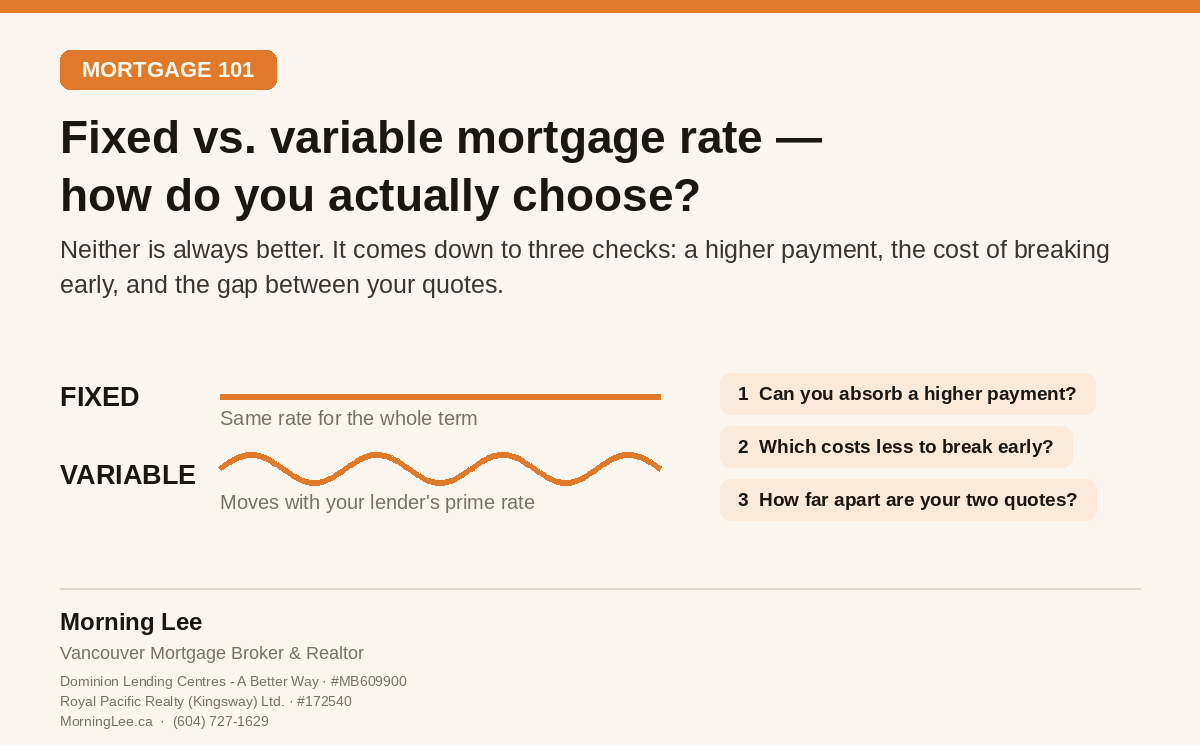
Neither one is better — one just fits your situation better than the other. A fixed rate locks your payment for the whole term (most commonly five years) regardless of what the central bank does in between. A variable rate moves with your lender's prime rate, which itself moves with the central bank's overnight rate, so it can change during your term. The real question isn't which one has historically been cheaper — it's two more specific things: can you handle your payment changing, and which one costs less if you break the mortgage early.
By Morning Lee (李会民) · Licensed mortgage broker #MB609900 · REALTOR® #172540 · Last updated 2026-09-27
What is a variable rate actually tracking?
A variable rate isn't random — it tracks a specific number: your lender's prime rate. Prime rate moves when the central bank moves its overnight rate, typically after a scheduled rate announcement. Your variable rate is usually written as "prime minus (or plus) some percentage," and that discount or premium is locked for your term — what moves is prime itself.
A fixed rate doesn't track anything. The day you sign, your rate for the whole term is set, and it doesn't matter what the central bank does afterward.
There are two kinds of variable — whether your payment itself changes depends on which one
One kind is an adjustable rate, where your payment amount changes whenever prime moves, and your amortization schedule stays roughly on track. The other keeps your payment amount fixed (sometimes called a VRM) — whatever prime does, you pay the same dollar figure every month, but the split between interest and principal inside that payment shifts.
The second kind has a mechanism worth knowing about: the trigger rate. If prime rises enough, your fixed payment can stop covering even the interest. What happens at that point depends on your lender: some raise your payment automatically; some add the unpaid interest to your balance, so what you owe grows; and some contact you ahead of time to suggest a lump-sum payment or switching to a fixed rate. Before signing a variable rate, ask which kind you're getting, roughly where your trigger rate sits, and what this lender does when you reach it. It's a question most people don't think to ask, but it's a practical one.
Breaking the mortgage early costs very different amounts
This is one of the most practical differences, and it's often missed when people are choosing. Breaking a variable-rate mortgage early usually costs three months' interest — a fixed, predictable calculation, and usually not a large number.
Breaking a fixed-rate mortgage early is calculated as the greater of three months' interest or an interest rate differential (IRD) — and the IRD depends on where rates sit at the time you break it. If rates have dropped a lot since you signed, that penalty can be a meaningfully larger number than most people expect. If there's a real chance you'll move, refinance, or switch lenders mid-term, this belongs in the decision up front, not something to work out after signing.
How much should you trust "variable is historically cheaper"?
Looked at over a long stretch — spanning multiple full rate-hike and rate-cut cycles — variable-rate borrowers have, on average, paid less total interest than fixed-rate borrowers. That's a real historical pattern, not just a talking point.
But "on average" doesn't mean "every single time." The most recent hiking cycle is a clear counter-example: people who chose variable saw their payments or interest costs rise meaningfully during those years, which doesn't match the "historically cheaper" line. The historical pattern is about long stretches across many cycles — it isn't a promise about how your specific five-year term will play out, and it shouldn't be treated as one.
What should actually drive the decision — not the rate number itself
Start with one question: if your payment went up by something like 15 to 20 percent, could your budget absorb that? If the honest answer is no, or barely, that alone matters more than which rate happens to be lower today — fixed buys you not having to do that math.
If you could absorb it, have some cushion, and don't mind keeping an eye on rate changes, variable offers a historically better average plus a smaller penalty if you need to break it. Which of those two matters more to you will decide this better than the rate numbers themselves.
Here is a more technical way to look at it, if it helps: take the variable rate you are quoted and the 5-year fixed rate you are quoted, and work out the gap between them (the spread). As a rule of thumb, if that gap is under 1 percentage point, the savings from future rate cuts usually do not outweigh the risk of a variable rate moving against you, so fixed tends to be the steadier choice; if the gap is 1.5 to 2 percentage points or more, variable's historical edge is more pronounced and worth serious consideration. The actual size of the gap depends on the real quotes you get from lenders on the day you apply, it is not a fixed number, but working out that gap is a more reliable way to decide than going on a gut sense of which one feels cheaper.
There's a middle option most people don't know about
Many lenders also offer a hybrid or combination mortgage — part of the loan is fixed, part is variable, splitting the risk between the two. If you want some certainty without giving up variable's historical edge entirely, this is a middle ground, though the product selection is narrower and not every lender offers it.
Separately, some variable-rate products let you convert to fixed partway through the term, often without penalty. Whether that option exists, and which day's fixed rate applies when you convert, varies a lot by lender — worth asking about specifically before you sign, not after you want to use it.
Common questions
How often does the prime rate actually change?
It moves around the central bank's scheduled rate announcements, which happen a set number of times a year — prime typically only changes after one of those, not randomly in between. Exact timing varies slightly by bank, but it's always tied to those announcements.
My fixed and variable quotes are close. Is it still worth agonizing over?
When the quotes are close, the decision comes down more to the early-break penalty and whether you can handle a payment change than to a fraction of a percentage point. Close pricing is actually a good moment to think about whether certainty or flexibility matters more to you.
What's a trigger rate, and how do I know if my variable mortgage has one?
It's the rate at which your fixed payment covers interest only, with nothing left for principal. You can ask your lender directly what your trigger rate would be for your specific mortgage — it's a concrete number, and you should be able to get a clear answer, not a vague one. If you've already signed, the same applies: ask your lender for the trigger rate on your mortgage. For a rough estimate yourself: monthly payment (principal and interest only) × 12 ÷ remaining balance — for example, $3,000 a month on $600,000 is about 6%.
Can I switch from variable to fixed partway through my term?
Some products allow it, but not every lender offers this, and the terms aren't standardized — which day's fixed rate applies and whether there's a fee both vary. If this matters to you, ask before you sign, not after you want to use it. If you've already signed a variable and are thinking of converting, start with your contract: whether conversion is allowed, which day's fixed rate applies, and any fee. Then run the "could I handle a 15–20% higher payment" test. If the terms are hard to follow, I'm happy to go through them with you.
I'm a first-time buyer and don't know my own risk tolerance. Where do I start?
Without much experience to go on, a reasonable starting point is asking whether a 15 to 20 percent payment increase would affect your life. If yes, start with fixed. If no, and you have some cushion, variable is worth considering seriously. This isn't a one-time, unchangeable decision either — renewal or refinancing gives you another chance to choose again.
Will rates come down? Should I wait before deciding?
No one can promise where rates go next, so I wouldn't choose based on a forecast. Run the three checks instead: whether you could handle a higher payment, the chance you'll break early, and the spread between your quotes.
How does this land on your file?
The above is general. How it works out for you takes about ten minutes on the phone.
✆(604) 727-1629