
Reverse mortgages in Canada: the four lenders, how they compare and how much you can get
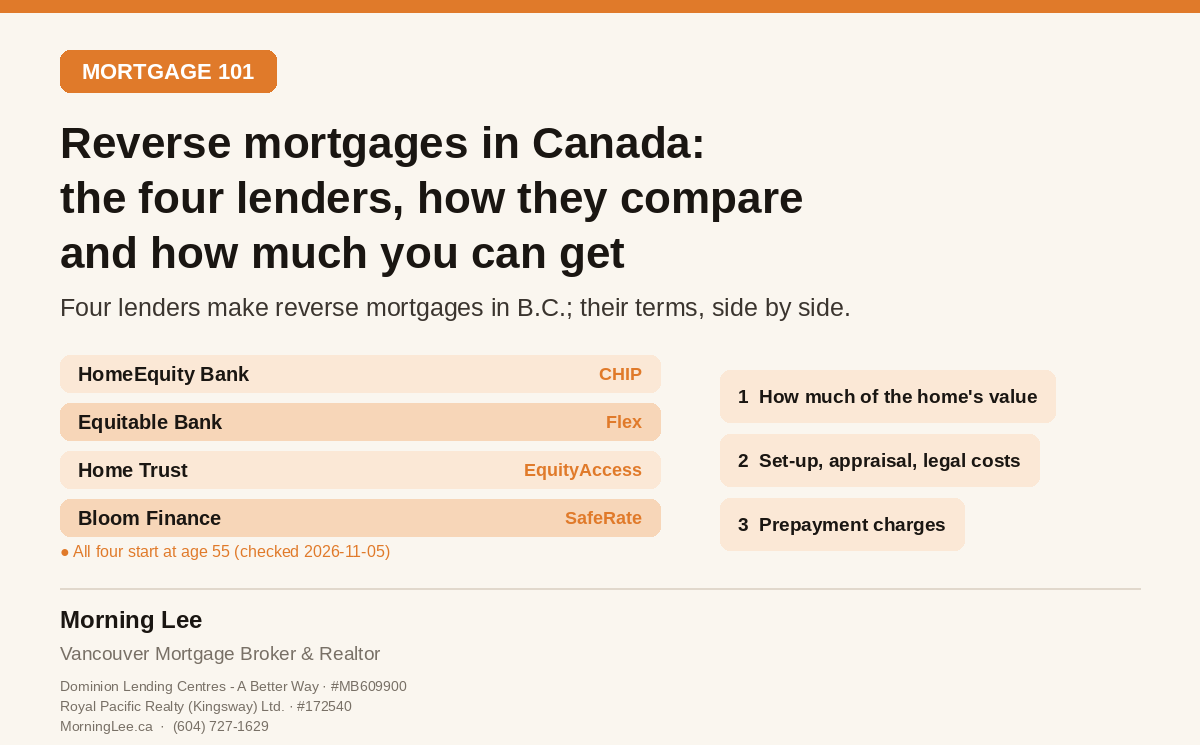
We found four lenders making their own reverse mortgages in B.C. today: HomeEquity Bank, Equitable Bank, Home Trust and Bloom Finance. Some banks and credit unions don't make them; they refer customers to these four. All four start at 55, and the Financial Consumer Agency of Canada says you can usually borrow up to 55% of your home's current value. Where they differ is how much they lend, how the money is paid out, what it costs to set up and what it costs to repay early. Below, lender by lender, every point was checked against the lender's own website on November 5, 2026. Rates change every week, so this page doesn't list them; to find out how much you could get and at what rate, fill in the form below or call me.
By Morning Lee (李会民) · Licensed mortgage broker #MB609900 · REALTOR® #172540 · Last updated 2026-11-11
First: what a reverse mortgage is, and where the cost is
A reverse mortgage (some people call it a reverse home loan or home equity release) is a loan for homeowners 55 and older, secured by the home, with no regular payments. The Financial Consumer Agency of Canada (FCAC) puts it this way: it is for homeowners usually aged 55 or older, you may usually borrow up to 55% of your home's current value, and you can take it as a lump sum or as regular payments.
With no payments, the interest is added to the loan, so the amount you owe keeps growing. You repay it all when you sell, move out, or when the last borrower dies, and you or your estate usually have a limited time to do it.
The cost shows up in two places. The rate is usually higher than on a regular mortgage or a home equity line of credit (HELOC), and there are fees: appraisal, set-up, legal and closing costs, plus a possible prepayment penalty if you pay it off early (all from the FCAC's list). CMHC also calls this option ultimately more expensive and highly recommends independent legal advice; in some provinces the lender requires it.
For how it works step by step, see What a reverse mortgage actually is — and how it works.
The four lenders
The four we found all say they lend in B.C.:
HomeEquity Bank: the CHIP family (CHIP, CHIP Max, CHIP Open, Income Advantage).
Equitable Bank: the Flex family (Flex, Flex PLUS, Flex Lite).
Home Trust: the EquityAccess family (EquityAccess, EquityAccess+, EquityAccess Boost), through mortgage brokers only.
Bloom Finance: Bloom's reverse mortgage, and SafeRate, with a rate fixed for life.
Some banks and credit unions don't make reverse mortgages themselves; they refer customers to these lenders. So whoever you ask first, the loan most likely comes from one of these four; start by comparing these four side by side. Some private lenders and mortgage investment corporations also make home equity loans with no regular payments; see “Other kinds of reverse loans” below.
HomeEquity Bank (CHIP)
Age: 55 and up, and every co-owner on title must be 55 too.
How much: up to 55% of your home's value, depending on your age, where the home is and its condition.
The home: worth at least $250,000 for CHIP and Income Advantage, and at least $300,000 for CHIP Max and CHIP Open (CHIP Max only in some locations). It must be your primary residence (you live there at least six months a year). Most houses, semi-detached homes, townhouses and condos qualify; second homes and rentals don't.
How the money is paid: CHIP pays a first lump sum (at least $25,000), and later advances may be available ($5,000 minimum each). Income Advantage pays monthly (at least $1,000) or quarterly (at least $3,000).
Fees: an appraisal of about $300 to $600, paid to the appraiser; independent legal advice of about $300 to $700, paid to a lawyer you choose; and a fee paid to HomeEquity Bank, usually taken from the loan, whose amount its website doesn't give.
Repaying early: CHIP Open is short-term and can be repaid in full at any time with no prepayment penalty; converting it to a CHIP later costs a $500 conversion fee. For the other products the website doesn't say how the charge is worked out, so ask the lender to calculate it from your contract.
The guarantee: HomeEquity Bank says what you or your estate eventually repay will never exceed the home's fair market value (fees and interest that builds up after the due date are not covered).
Your part: maintain the home and pay the property taxes and insurance.
Equitable Bank (Flex)
Three products: Flex, from 55, 15% to 55% of the home's value; Flex PLUS, from 70, 43% to 59% (another table on the same page says 44% to 59%); Flex Lite, from 55, 15% to 40%. The amount depends mainly on your age and the appraised value.
The home: appraised at $250,000 or more, in cities and most large towns in B.C., Alberta, Ontario and Quebec.
How the money is paid: with Flex and Flex PLUS, take it all at once, or take a large sum first (at least $25,000) and the rest later as single or scheduled advances; Flex Lite pays one lump sum only.
Fees: a $995 set-up fee, plus appraisal, independent legal advice and legal and closing costs.
Repaying early: you can repay up to 10% of the principal every 12 months with no charge. Beyond that, the charge is 5, 4 and 3 months' interest in years 1, 2 and 3, then 3 months' interest in years 4 to 10, and nothing from year 11; from year 6 you can repay the whole balance with no charge on 3 months' written notice.
The guarantee: what you owe on the due date won't exceed the home's fair market value.
Your part: pay the property taxes directly to the municipality; if the home needs repairs, the lender may hold back part of the money to cover them.
Home Trust (EquityAccess)
Three products: EquityAccess, from 55, one lump sum; EquityAccess+, from 55, a lump sum plus scheduled advances; EquityAccess Boost, from 70, access to a larger share of your equity.
Where, and who to ask: Ontario, Nova Scotia, Alberta and B.C., through mortgage brokers only; Home Trust's own page says to contact a mortgage broker to apply.
Fees: the page shows two tables, one with a $995 set-up fee and one with $0; it doesn't say which applies to you, so ask.
Not on the page: the maximum share of your home's value, the minimum home value and the prepayment charges aren't on Home Trust's own page, so they have to be asked one by one for your age and your home.
Bloom Finance (including SafeRate)
Age and where: 55 and up, in Ontario, B.C. and Alberta, with some areas excluded; the home must be your principal residence.
How much: up to 55% of your home's value.
SafeRate: Bloom calls it Canada's first lifetime fixed-rate reverse mortgage (that is Bloom's own claim).
Fees: a flat $2,300 — processing $1,650, appraisal $350 and independent legal advice $300 (an estimate) — taken from the loan.
Repayment: no fixed repayment date.
Repaying early: Bloom's website doesn't say how the charge is worked out. With a rate fixed for life, get the prepayment charge explained and written into the contract before you sign.
The four side by side: five things to compare
Age: all four start at 55; Equitable Bank's Flex PLUS and Home Trust's EquityAccess Boost start at 70 and lend a larger share. HomeEquity Bank requires every co-owner on title to be 55 or older; for how much you can get, most lenders go by the younger owner's age.
How much: HomeEquity Bank and Bloom say up to 55%; Equitable Bank, 15% to 59% depending on the product; Home Trust doesn't say. These are all maximums; what you actually get depends on the younger owner's age, where the home is, what kind of home it is and what it appraises at.
How the money is paid: all can pay a lump sum; HomeEquity Bank, Equitable Bank and Home Trust also have products that pay in stages or on a schedule; Bloom's page only says the money goes into your bank account. If you need it to top up monthly living costs, taking it in stages usually means less interest; see What do people actually use reverse mortgage money for — and should you take it as a lump sum or in stages?
Set-up costs: Equitable Bank, a $995 set-up fee plus appraisal and legal; Bloom, a flat $2,300 that includes the appraisal and independent legal advice; HomeEquity Bank, about $300 to $600 for the appraisal and $300 to $700 for independent legal advice, plus its own fee; Home Trust, a $995 or $0 set-up fee.
Prepayment charges: Equitable Bank spells them out most clearly (see above); HomeEquity Bank's CHIP Open has none; for the other products the websites don't say, so ask before you sign. If you might sell or move within a few years, or want to pay it off early, this matters more than the rate.
Rates: not listed here. They change every week, and the same lender's rate is often different from one website to the next; a reverse mortgage rate is usually higher than a regular mortgage or a HELOC (FCAC). To compare, ask them all on the same day for the same term.
Other kinds of reverse loans: private lenders and mortgage investment corporations
The four lenders above make one kind of product, the reverse mortgage. Beyond them, some private lenders and mortgage investment corporations (MICs) make home equity loans with no regular payments, which can be seen as another kind of reverse loan. A common setup is that the interest for a set period is taken out of the loan up front, so nothing is due each month during that period.
How they differ from the four: the term is short, usually a year or two, and at the end you repay it or renew for another term, usually with another round of fees; the rate, the lender's fee and the broker's fee are usually higher than with the four, and they vary a lot from one lender to the next; and how much of the home's value you can borrow, whether age matters, and whether what you owe at the end is capped at the home's value all depend on the contract, so go through it line by line.
Who it suits: people who need the money for a short time (waiting for a sale to close, or for funds to arrive), or whose situation doesn't fit the four (under 55, or a type or location of home the four don't lend on). If you plan to stay for the long term and don't want to redo it when the term ends, look at the four first.
How to compare: for the same amount, add up the interest for the whole term, every fee and the legal costs to get the total cost; then ask what happens when the term ends and how early repayment is charged.
Before you sign: run the numbers on the other options
A reverse mortgage isn't the only way. CMHC lists two others: refinancing, up to 80% of your home's value, repaid monthly over 25 or 30 years, which often provides the best interest rate; and a HELOC, up to 65% of the home's value, where the minimum monthly payment is just the interest and the rate is variable. Both are approved on your income; if you qualify and can carry the payments, they usually cost less than a reverse mortgage.
There is also selling and moving somewhere smaller, or renting: the money comes out of the house in one go with no interest to pay, though selling and moving have their own costs. Which one fits depends on your monthly income, whether you want to stay in this house, and how much you want to leave your children.
Two guides compare them directly: Reverse mortgage or a HELOC — how do you choose? and Reverse mortgage or a cash-out refinance — how do you choose?
How much could a reverse mortgage give you? Tell me five things
The younger owner's age, the city, the type of home (house, townhouse or condo), roughly what it's worth and what's still owing. With those five, I can work out a first estimate under each lender's rules: which lenders would do it, and roughly how much you could get.
A first estimate doesn't need your date of birth or street address; the lender asks for those when you actually apply. Fill in the form below or call (604) 727-1629; the estimate is free. I'll put the lenders' terms side by side for you.
Common questions
How many lenders offer reverse mortgages (reverse home loans) in Canada? Do the big banks?
We found four lenders making their own reverse mortgages in B.C. today: HomeEquity Bank, Equitable Bank, Home Trust and Bloom Finance. Some banks and credit unions don't make them; they refer customers to these lenders. Start by comparing these four side by side. Some private lenders and mortgage investment corporations also make no-payment home equity loans; see “Other kinds of reverse loans”.
Which lender has the lowest rate?
This page doesn't list rates: they change every week, and the same lender's rate is often different from one website to the next, so anything written here would soon be wrong. Compare rates on the same day for the same term, and don't look at the rate alone; set-up costs and prepayment charges can add up to more than the rate difference over a few years.
If two of us own the home, whose age counts?
HomeEquity Bank requires every co-owner on title to be 55 or older. For how much you can get, most lenders go by the younger owner's age, and the older you are, the larger the share usually is. That is why the form below asks for the younger owner's age.
Do I still own my home? Could I end up owing more than it's worth?
You still own it: HomeEquity Bank says you keep ownership and title, and your part is to maintain the home and pay the property taxes and insurance; the FCAC notes that letting the home fall into disrepair can put you in default. As for the debt, HomeEquity Bank and Equitable Bank both guarantee that what you repay won't exceed the home's fair market value (each with conditions); we didn't find the same statement on Home Trust's or Bloom's pages, so ask before you sign.
My parents want a reverse mortgage. How can I help?
Start by running the numbers on the other options with them: a HELOC, refinancing, or selling and moving somewhere smaller. If they go ahead, they should get independent legal advice from their own lawyer before signing (CMHC highly recommends it). And know that because the interest keeps compounding, there will be less left in the estate (one of the downsides the FCAC lists); talk that through as a family first.
#MorningLee #VancouverMortgageMorningLee #VancouverRealtorMorningLee
How does this land on your file?
The above is general. How it works out for you takes about ten minutes on the phone.
✆(604) 727-1629Sources
The rules, ratios, amounts and dates on this page come from the sources below; the date after each one is when it was opened and checked. Each lender's product terms are published only on its own website, so the sources include the lenders' own product pages. Terms and fees change, so go by each lender's latest version; this page does not list rates.
- Financial Consumer Agency of Canada (FCAC): Reverse mortgages (checked 2026-11-05)
- Canada Mortgage and Housing Corporation (CMHC): Mortgage financing options for people 55 and above (2018-05-24) (checked 2026-11-05)
- HomeEquity Bank (lender's own page): What is my Reverse Mortgage Eligibility (2025-11-13) (checked 2026-11-05)
- HomeEquity Bank (lender's own page): Compare CHIP Reverse Mortgage Options (checked 2026-11-05)
- HomeEquity Bank (lender's own page): CHIP Open (checked 2026-11-05)
- HomeEquity Bank (lender's own page): Reverse Mortgage Costs In Canada (updated 2026-03-23) (checked 2026-11-05)
- HomeEquity Bank (lender's own page): How Do Reverse Mortgages Work in Canada (checked 2026-11-05)
- Equitable Bank (lender's own page): Reverse mortgages (product comparison) (checked 2026-11-05)
- Equitable Bank (lender's own page): Reverse mortgage FAQ (checked 2026-11-05)
- Home Trust (lender's own page): Reverse Mortgage (EquityAccess) (checked 2026-11-05)
- Bloom Finance (lender's own page): Reverse Mortgage in Canada for Homeowners 55+ (checked 2026-11-05)
- Bloom Finance (lender's own page): Reverse Mortgage Rates & Fees (checked 2026-11-05)
- Bloom Finance (lender's own page): Bloom SafeRate (checked 2026-11-05)