
Switching lenders for a lower rate: how the penalty is calculated, and when switching pays off
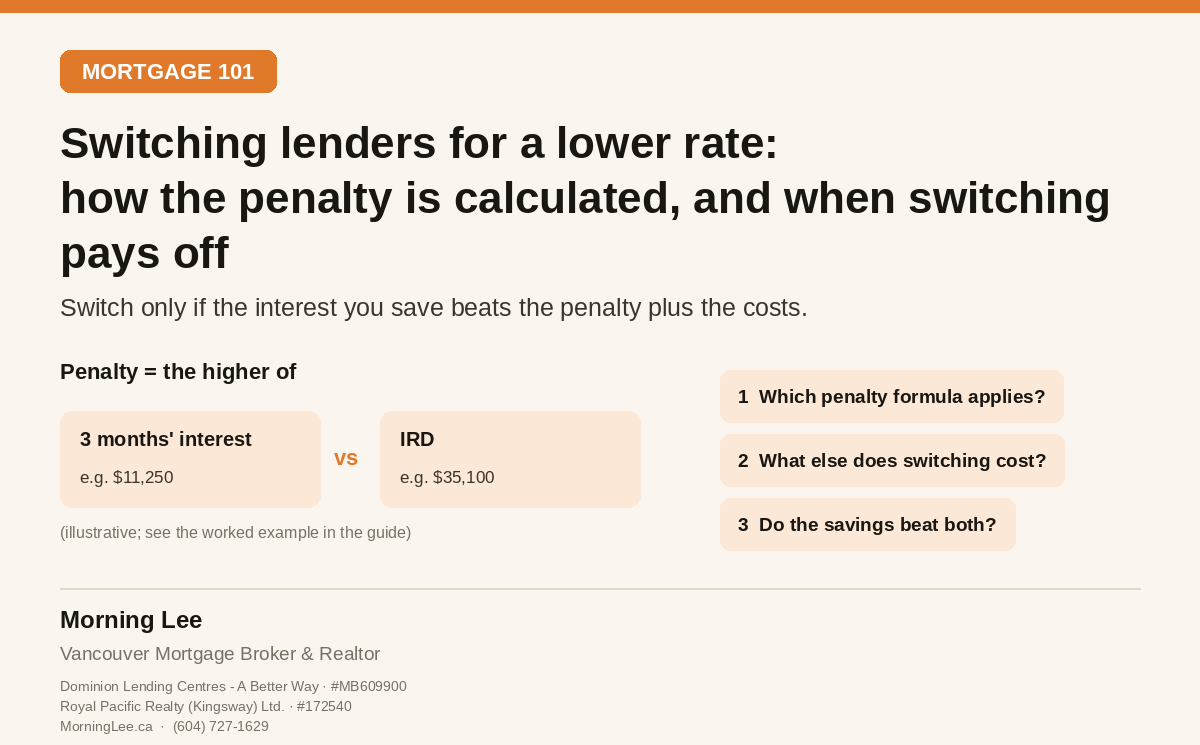
Switch lenders mid-term and your current lender will usually charge the higher of three months' interest or the interest rate differential (IRD). Whether switching pays comes down to what the lower rate saves you over the rest of the term, minus the penalty and the costs of switching. If plenty is left over, switch; if little or nothing is, wait until maturity — switching lenders at maturity carries no prepayment penalty.
By Morning Lee (李会民) · Licensed mortgage broker #MB609900 · REALTOR® #172540 · Last updated 2026-10-28
When you pay a penalty
Moving your mortgage to another lender before the end of the term triggers a prepayment penalty. So does paying the whole mortgage off during the term (including when you sell), or prepaying more in a year than your contract allows.
Switch once the term is over and the contract is complete, so there's no penalty. That's why the first thing to check is how long is left: with only a few months to go, waiting for maturity usually comes out ahead. For when to start preparing, see How early can you lock a rate before renewal?
Three months' interest: the simple one
Three months' interest is exactly that — three months of interest at your current rate. An example (illustrative numbers, not a quote): on a $900,000 balance at 5%, three months' interest is about $900,000 × 5% × 3 ÷ 12 = $11,250.
On a variable-rate mortgage, this is usually the whole penalty (check your contract). On a fixed rate, the lender also works out an IRD and charges whichever is higher.
The IRD: the same situation can produce very different numbers
The IRD uses two interest rates: the lender works out the interest left to pay over the rest of your term at each rate, and the difference is the IRD. The first rate is usually your contract rate (some lenders use the posted rate when you signed). The second is the lender's current rate for a term about as long as what you have left — some lenders use the current posted rate, others the current posted rate minus the discount you were originally given.
Lenders usually apply the IRD when your contract rate is higher than current rates and you signed less than five years ago. The Financial Consumer Agency of Canada (FCAC) gives an example: a $200,000 balance at 6%, 36 months left on a 5-year term, and the lender's current posted 3-year rate at 4%. Three months' interest is about $3,000, the IRD about $12,000, and the penalty is the higher figure: $12,000.
Now see what subtracting the discount can do (illustrative numbers): an engineer owes $900,000 at a contract rate of 5% (the posted rate at signing was 6.5%, with a 1.5-point discount) and has three years left. The lender's posted 3-year rate today is 5.2%. If the lender compares 5% with 5.2%, your rate isn't higher than today's, so the penalty is three months' interest: $11,250. If it compares 5% with 5.2% minus the original 1.5-point discount — 3.7% — the gap is 1.3 points, and the IRD works out to roughly $900,000 × 1.3% × 3 = $35,100. Same person, same mortgage, a penalty more than $20,000 apart.
So step one is to call your lender and ask: if I break the mortgage today, what's the penalty, and how is it calculated? Your lender must tell you how it calculates it.
The costs of switching beyond the penalty
The new lender's setup costs can include discharge, registration, transfer or assignment fees from your current lender; an appraisal fee if one is needed; and other administration fees. Ask whether the new lender will cover some or all of your switching costs.
The new lender has to approve your application, and its criteria may differ from your current lender's. The minimum-qualifying-rate exemption from the Office of the Superintendent of Financial Institutions (OSFI) covers a same-amount switch to another lender at renewal; switch mid-term to a federally regulated lender and you still have to pass the stress test.
One formula: does switching pay?
Interest saved ≈ (your current rate − the new rate) × balance × years left; then subtract the penalty and the switching costs. If the result is still positive, and big enough to be worth the effort, switch.
Back to the engineer: the new lender offers 3.9% for three years, so the rough saving is $900,000 × (5% − 3.9%) × 3 ≈ $29,700 (a little less in practice, since the balance is coming down). With a penalty of three months' interest — $11,250 — and a few thousand dollars in costs, over $10,000 is left: worth switching. With the IRD of $35,100, it doesn't pay; better to wait for maturity, or ask your current lender about renewing early.
If your income structure has just changed, ask first whether you'll be approved. A newly made partner at a law or accounting firm, a business owner who just moved from salary to dividends, or a salesperson new to commission will usually need two years of the new income on record with a new lender — the interest saving won't matter if the application fails. See Making partner, switching to dividends, or opening your own practice — should you buy now, or wait?
Ways to get a better rate without switching lenders
Negotiate with your current lender: bring a written quote from another lender, and some lenders will improve your terms to keep you.
Renew early (blend-and-extend): some lenders let you extend the mortgage mid-term, blending your old rate with the new term's rate. There's no prepayment penalty, though there may be administrative fees, and the lender has to tell you how the new rate is calculated.
Use your annual prepayment privileges in full: future penalties are then calculated on a lower balance. A lump-sum prepayment before you break the mortgage also lowers the penalty (some lenders restrict prepayments close to the date you break the contract).
Common questions
Can the penalty be negotiated?
The penalty follows your contract. What's usually negotiable is whether the new lender will cover part of the switching costs, and whether your current lender will let you renew early instead of breaking the mortgage.
Do I pay a penalty if I sell?
Paying off the mortgage when you sell mid-term usually triggers one. If you're buying again in Canada, ask whether you can take the mortgage with you (a portable mortgage), which avoids breaking it; if the new home costs less than your mortgage balance, you may still pay a penalty.
What's the penalty for switching a variable-rate mortgage?
Usually three months' interest (check your contract), which is far easier to work out than a fixed-rate IRD — so for a variable borrower, whether a mid-term switch pays mostly depends on the new rate and the costs.
Six months are left on my term. Switch now or wait?
The penalty applies in full, and there are only six months of savings to offset it, so waiting until maturity usually wins. You can start comparing and locking a rate a few months before the term ends.
Rates are much lower than when I signed. Should I switch as soon as possible?
Not necessarily. The further rates fall, the larger the IRD tends to be — it's built on the gap between your contract rate and today's rate, multiplied by the time left. Get today's penalty figure first, then run the formula above.
#MorningLee #VancouverMortgageMorningLee #VancouverRealtorMorningLee
How does this land on your file?
The above is general. How it works out for you takes about ten minutes on the phone.
✆(604) 727-1629Sources
The rules, ratios, amounts and dates on this page come from the sources below; the date after each one is when it was opened and checked. Rules and fees change, so go by the latest version from each source.
- Financial Consumer Agency of Canada (FCAC): Mortgage fees: Prepayment penalties (checked 2026-10-28)
- Financial Consumer Agency of Canada (FCAC): Breaking your mortgage contract (checked 2026-10-28)
- Financial Consumer Agency of Canada (FCAC): Renewing your mortgage (checked 2026-10-28)
- Financial Consumer Agency of Canada (FCAC): Choosing a mortgage that is right for you (checked 2026-10-28)
- Office of the Superintendent of Financial Institutions (OSFI): Minimum qualifying rate for uninsured mortgages (checked 2026-10-28)
- Office of the Superintendent of Financial Institutions (OSFI): OSFI exempts uninsured mortgage straight switches from the prescribed MQR and implements portfolio LTI limits (checked 2026-10-28)