
Want to refinance before your renewal? Now or at maturity — how to weigh the penalty against the rate
Put the extra cost of each side next to the other. Do it now and you pay a penalty for breaking the mortgage, and the whole balance moves to the new rate from today. Wait and you pay interest on high-rate debt for the months in between — and you have to ask whether what you need the money for can wait. Whichever costs less wins. If that's waiting, refinance at maturity: the contract is complete, so there's no prepayment penalty, although you still need a new approval and the stress test.
By Morning Lee (李会民) · Licensed mortgage broker #MB609900 · REALTOR® #172540 · Last updated 2026-10-28
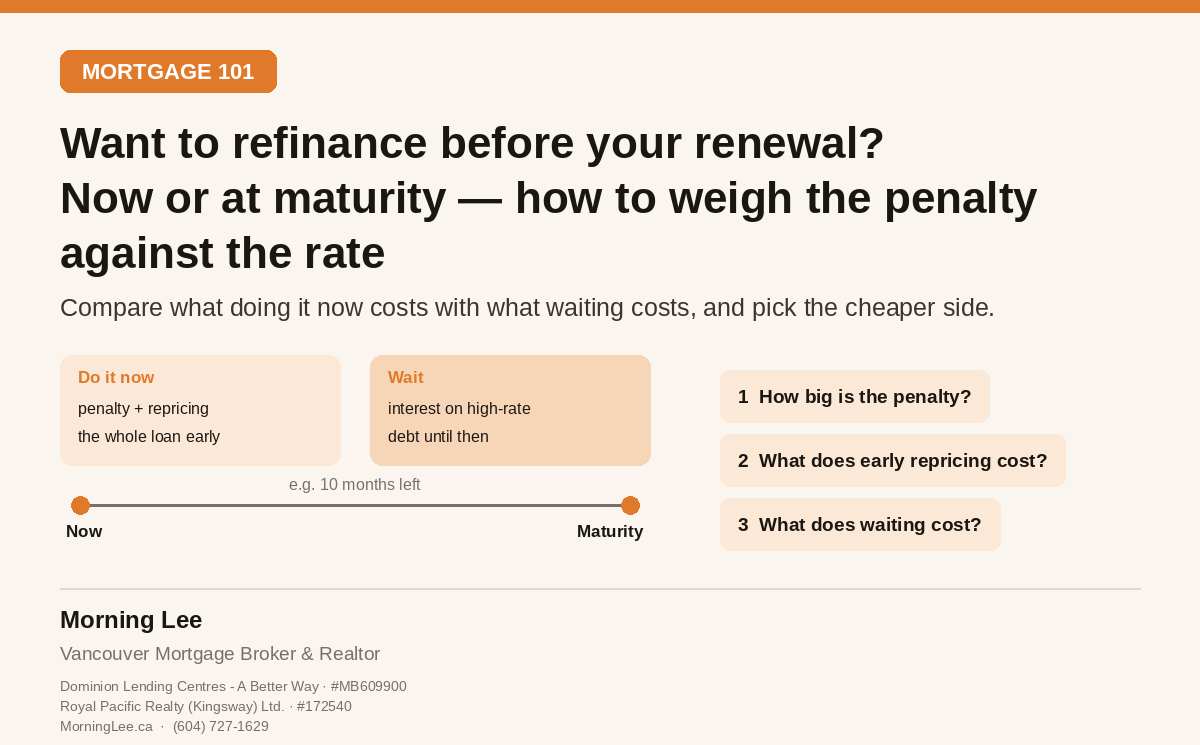
What doing it now costs
The penalty: usually the higher of three months' interest or the interest rate differential (IRD).
Repricing the whole mortgage early: a refinance is a new mortgage, so it generally isn't just the new money — your existing balance moves to the new rate from today. If your contract rate is below today's rates, this often costs more than the penalty.
Fees: the appraisal, title search, title insurance and legal fees. You'd pay these at maturity too, so you can leave them out of the comparison.
What waiting costs
The interest you keep paying on high-rate debt over those months — credit cards, a line of credit, a car loan. The higher the rate and the further away maturity is, the bigger this gets.
Some needs can't wait: a practice renovation on a schedule, a tax bill coming due, a child's tuition, the down payment on your next property. If yours can't, look at the bridging options below.
Two situations, two different calculations
Your contract rate is below today's (a low rate locked in a few years ago): lenders usually apply the IRD only when your contract rate is higher than current rates, so the penalty will most likely be three months' interest — but repricing the whole mortgage early is a big cost. An example (illustrative numbers, not a quote): an executive owes $700,000 on a 5-year fixed at 2.69%, with 10 months to go, and wants to take out $150,000 to clear a line of credit at 8%. Doing it now: three months' interest is about $700,000 × 2.69% × 3 ÷ 12 ≈ $4,700. If the new rate is 4.4%, moving the $700,000 to 4.4% ten months early costs about $700,000 × (4.4% − 2.69%) × 10 ÷ 12 ≈ $9,975. What it saves is ten months of interest on the $150,000 line of credit: about $150,000 × (8% − 4.4%) × 10 ÷ 12 = $4,500. Doing it now costs roughly $10,000 more, so waiting until maturity wins.
Your contract rate is above today's (signed when rates were high): moving the whole mortgage to the new rate saves money, but the penalty will most likely be the IRD — which is built on exactly that gap between your rate and today's — so the savings and the penalty often come out close. Compare the actual penalty figure from your lender with the interest you'd save over the rest of the term; the method is in Switching lenders for a lower rate: how the penalty is calculated, and when switching pays off.
Can't wait, but don't want to pay the penalty? Two ways to bridge
Open a home equity line of credit (HELOC), or use a line you already have, to replace the most expensive debt now, then refinance everything at maturity. A HELOC also requires approval and the stress test, and can go up to 65% of the home's value.
Ask your current lender about renewing early (blend-and-extend): your old rate is blended with the new term's rate, with no prepayment penalty, though there may be administrative fees. Whether you can borrow more at the same time, and how the new money is priced, varies by lender — ask, and get it in writing.
If you're waiting for maturity, when to start
A federally regulated lender, such as a bank, must send you a renewal statement at least 21 days before the term ends. A refinance needs a new approval and an appraisal, though, so start a few months ahead rather than waiting for the statement — see How early can you lock a rate before renewal?
A refinance at maturity means passing the stress test, whether you stay with your lender or move. The exemption for switching lenders at maturity covers only a same-amount switch with no longer amortization; borrowing more money takes you out of it.
Common questions
If I refinance at maturity, is there a penalty?
There's no prepayment penalty, because the contract is complete. You still need a new approval, an appraisal and the stress test, and you still pay costs such as the appraisal and legal fees.
My mortgage is variable. What would the penalty be to refinance now?
Usually three months' interest (check your contract). For a variable mortgage, refinancing early mostly costs those three months' interest plus the usual fees, which is easier to work out than with a fixed rate.
Is refinancing with my current lender easier?
Your current lender already has your file, so the paperwork may be simpler. Get the penalty and the new rate in writing and compare them with other lenders' offers; your lender has to tell you how the penalty is calculated.
Can I lengthen the amortization when I refinance?
A refinance is a new mortgage, so the amortization can be set again. A longer one lowers the payment and raises total interest.
Rates are much lower than when I signed. Should I refinance right away?
If today's rates are below yours, the penalty will most likely be the IRD, and the further rates have fallen, the larger the IRD tends to be. Get today's penalty figure first, then work out the interest you'd save over the rest of the term.
#MorningLee #VancouverMortgageMorningLee #VancouverRealtorMorningLee
How does this land on your file?
The above is general. How it works out for you takes about ten minutes on the phone.
✆(604) 727-1629Sources
The rules, ratios, amounts and dates on this page come from the sources below; the date after each one is when it was opened and checked. Rules and fees change, so go by the latest version from each source.
- Financial Consumer Agency of Canada (FCAC): Mortgage fees: Prepayment penalties (checked 2026-10-28)
- Financial Consumer Agency of Canada (FCAC): Breaking your mortgage contract (checked 2026-10-28)
- Financial Consumer Agency of Canada (FCAC): Borrowing against home equity (checked 2026-10-28)
- Financial Consumer Agency of Canada (FCAC): Renewing your mortgage (checked 2026-10-28)
- Financial Consumer Agency of Canada (FCAC): Preparing to get a mortgage (checked 2026-10-28)
- Financial Consumer Agency of Canada (FCAC): Home equity lines of credit (checked 2026-10-28)
- Office of the Superintendent of Financial Institutions (OSFI): OSFI exempts uninsured mortgage straight switches from the prescribed MQR and implements portfolio LTI limits (checked 2026-10-28)
- Department of Finance Canada: "Straight Switches" and portfolio insurance (checked 2026-10-28)