
Refinancing to pay off credit cards and a car loan: how much you save each month, and what to watch for
Your monthly saving = what those debts cost you each month now, minus how much your mortgage payment goes up once they're rolled in. Credit cards and car loans carry high rates and short payoff periods; folded into a mortgage amortized over 25 years or so, the payment often drops by a lot. But what you save is monthly cash flow, not necessarily interest: stretch the payoff out and total interest can go up. What to watch for: a refinance means a new approval and the stress test, you can generally borrow up to 80% of the home's value, doing it mid-term triggers a penalty, and the debt is now secured by your home.
By Morning Lee (李会民) · Licensed mortgage broker #MB609900 · REALTOR® #172540 · Last updated 2026-10-28
How much you save each month: an example
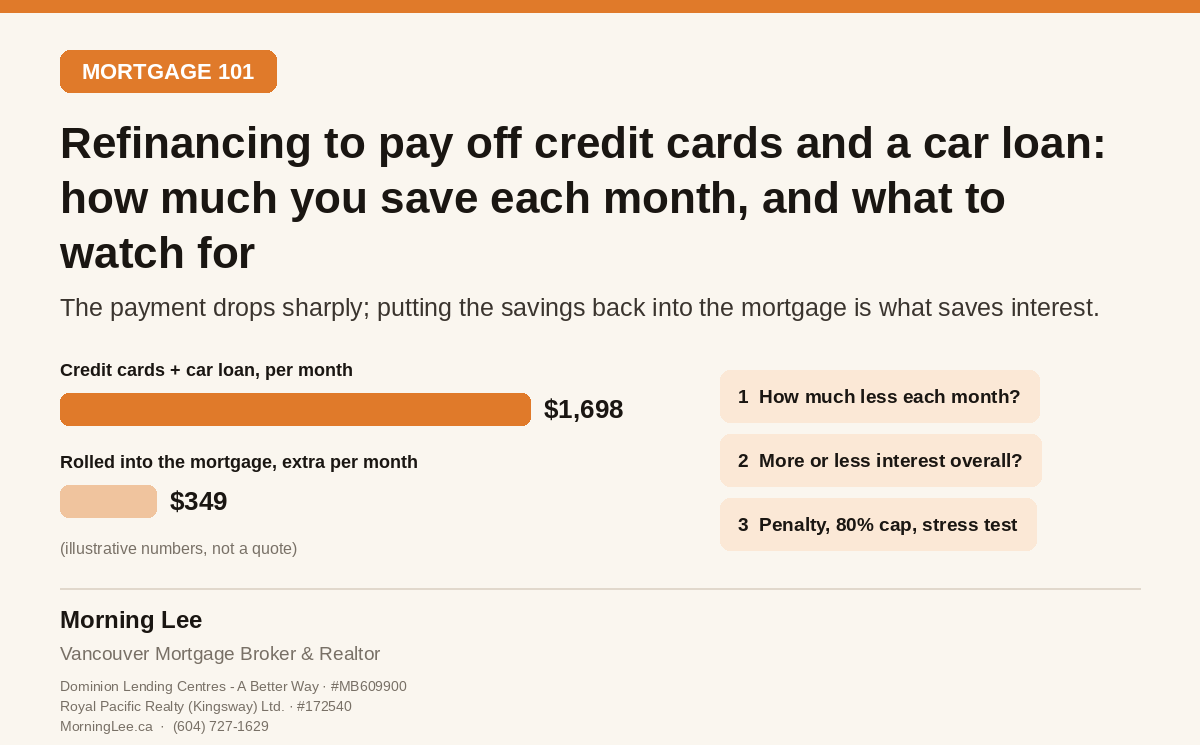
An example (illustrative numbers, not a quote): $18,000 on credit cards at 19.99%, paying $600 a month — at that pace it takes 42 months to clear and costs about $7,155 in interest; and a $45,000 car loan at 7.99% with 48 months left at $1,098 a month, about $7,722 in interest still to come. Together, that's $1,698 a month.
Roll the $63,000 into the mortgage at, say, 4.5% over a 25-year amortization, and the payment rises by only about $349. You pay about $1,350 less each month.
You save on the payment, not necessarily on interest
Pay that $63,000 off slowly over 25 years and the interest comes to about $41,600 — over $20,000 more than the roughly $14,900 the two debts would have cost. The Financial Consumer Agency of Canada (FCAC) warns about exactly this: consolidating can extend your repayment period and cost more in interest over time.
To actually save interest, keep putting $1,698 a month toward it after the refinance and send the difference to the mortgage as prepayments: the $63,000 is gone in about 40 months, with about $4,900 in interest — roughly $10,000 less than the original two debts. That depends on your contract allowing prepayments of that size each year (your prepayment privilege), so check before you sign.
A refinance isn't automatic: new approval, the stress test, and an 80% cap
A cash-out refinance is effectively a new mortgage: your income and credit are reviewed again, you have to pass the stress test, and the home gets a new appraisal.
You can generally borrow up to 80% of the home's value (80% is the legal maximum for uninsured mortgages). For example, if the home appraises at $1.5 million and you owe $900,000, the most you can borrow is $1.5 million × 80% = $1.2 million — up to $300,000 out. Whether your income can carry the new payment is a separate hurdle.
A cash-out refinance generally can't be insured (a refinance to build a secondary suite is the exception), so it's priced from the uninsured tier — and the new rate generally applies to the whole mortgage, not just the new money.
If your term isn't up, work out the penalty first
Refinancing mid-term means breaking your contract, which usually costs a penalty: the higher of three months' interest or the interest rate differential (IRD). On top of that come appraisal fees, title search and title insurance fees, and legal fees.
If the penalty and fees would eat several months of the payment savings, consider moving the most expensive debt (usually the credit cards) onto a line of credit for now and doing the refinance at maturity. For how to weigh now against later, see Want to refinance before your renewal? Now or at maturity — how to weigh the penalty against the rate.
Another route: a home equity line of credit (HELOC)
A HELOC can go up to 65% of the home's value, and you pay interest only on what you use; it also requires approval and the stress test. Many lenders let you pay only the interest each month — the lowest possible payment, but the principal never goes down.
If you use a HELOC to clear credit cards, set a payoff schedule and pay principal down on it every month, so it doesn't turn into a debt that never ends.
When to hold off
If the credit cards built up because you spend more than you earn each month: as FCAC points out, keep the spending habits that caused the debt and you'll accumulate more. Refinance, run the cards up again, and you've simply added another debt to the house.
If the car loan has only a year or so left, or carries a very low promotional rate: rolling it in saves little, and stretching it over 25 years can cost more.
If your income is unsteady or the payments are already tight: this money is now secured by your home, and as FCAC notes, if you can't repay what you borrow you may face serious consequences, including foreclosure.
Common questions
My mortgage term has two years left. Can I refinance now?
Yes, but you'll usually pay a penalty for breaking it, plus costs such as the appraisal and legal fees. Get today's penalty figure and compare it with waiting until maturity.
Does the amortization restart when I roll the debts in?
Yes. A refinance is a new mortgage, so the amortization is set again. A longer amortization lowers the payment and raises total interest.
How much can I take out, and how is it worked out?
Generally 80% of the home's new appraised value, minus what you still owe. Whether you get all of it also depends on your income supporting the new payment and passing the stress test.
Besides credit cards and a car loan, can I roll in a line of credit or a student loan?
Yes, and the math is the same: compare the total monthly payments, then the total interest. A debt that already carries a low rate (some student loans, for example) may not be worth rolling in.
What's the best use of the money I save each month?
To save interest, put it toward the mortgage and use your annual prepayment privilege in full; if you still have other high-interest debt, pay down the highest rate first.
#MorningLee #VancouverMortgageMorningLee #VancouverRealtorMorningLee
How does this land on your file?
The above is general. How it works out for you takes about ten minutes on the phone.
✆(604) 727-1629Sources
The rules, ratios, amounts and dates on this page come from the sources below; the date after each one is when it was opened and checked. Rules and fees change, so go by the latest version from each source.
- Financial Consumer Agency of Canada (FCAC): Debt consolidation (checked 2026-10-28)
- Financial Consumer Agency of Canada (FCAC): Borrowing against home equity (checked 2026-10-28)
- Financial Consumer Agency of Canada (FCAC): Preparing to get a mortgage (checked 2026-10-28)
- Office of the Superintendent of Financial Institutions (OSFI): Clarification on the Treatment of Innovative Real Estate Secured Lending Products under Guideline B-20 (checked 2026-10-28)
- Canada Mortgage and Housing Corporation (CMHC): Mortgage financing options for people 55+ (checked 2026-10-28)
- Financial Consumer Agency of Canada (FCAC): Home equity lines of credit (checked 2026-10-28)
- Financial Consumer Agency of Canada (FCAC): Home equity lines of credit: Market trends and consumer issues (checked 2026-10-28)
- Financial Consumer Agency of Canada (FCAC): Mortgage fees: Prepayment penalties (checked 2026-10-28)
- Financial Consumer Agency of Canada (FCAC): Choosing a mortgage that is right for you (checked 2026-10-28)
- Department of Finance Canada: Mortgage Insurance Rule Changes to Enable Homeowners to Add Secondary Suites (checked 2026-10-28)