
Over $1.5 million and no mortgage insurance: why a bigger down payment can get a higher rate, and how to compare
Because lenders price a mortgage first by whether it's insured, not by how much you put down. With insurance, the insurer covers the loss if the borrower can't pay, so the lender takes less risk and quotes less. At $1.5 million or more, mortgage insurance isn't available at all, the minimum down payment is 20%, and all the risk stays with the lender — so the quote comes from the uninsured tier. The Bank of Canada has made the same point: since insurance protects the lender, an insured mortgage may get a lower rate than an uninsured one with a bigger down payment. To compare, line up uninsured quotes for the same term and amortization from several lenders, then look at down-payment tiers, prepayment privileges and how the penalty is calculated.
By Morning Lee (李会民) · Licensed mortgage broker #MB609900 · REALTOR® #172540 · Last updated 2026-10-28
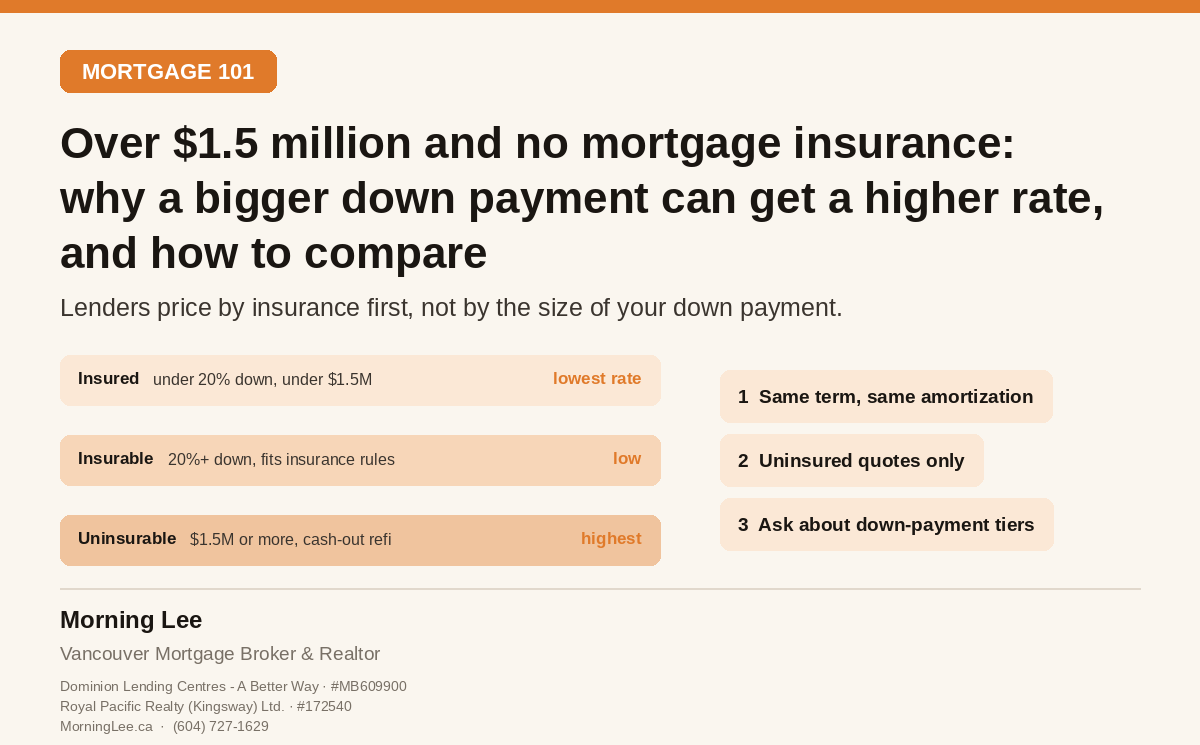
Rates come in three tiers: insured, insurable by the lender, and uninsurable
Tier one is insured: under 20% down, mortgage insurance is required, and the price has to be under $1.5 million. The insurance protects the lender — if you can't pay, the insurer pays the lender; it doesn't protect your home.
Tier two is 20% or more down, but a mortgage that fits the insurance rules: some lenders insure batches of these loans themselves (portfolio insurance) so they can fund them through government-sponsored securitization programs, and pricing in this tier is often good too. The conditions include a purchase (not a cash-out refinance), an amortization of no more than 25 years, and a property value under the set cap.
Tier three is uninsurable: a price of $1.5 million or more, a cash-out refinance (with one exception: since January 15, 2025, a refinance to build a secondary suite can be insured), an amortization longer than insurance allows, and so on. A home at $1.5 million or more is in this tier no matter how much you put down.
Why uninsured mortgages are priced a little higher
With an insured mortgage, the insurer bears the loss if a borrower defaults; with an uninsured one, the lender does. As the Bank of Canada explains, the money lenders lend out comes from depositors and investors, and that funding cost makes up most of your mortgage rate. Insured mortgages carry less risk and have more funding channels, so they price lower.
That's how it happens: in the same month, a friend buying a $1.2 million home with 10% down gets a lower rate than you do on a $1.8 million home with 30% down. Your file isn't weaker — the two mortgages simply sit in different tiers.
The rule is the same for everyone. At mainstream lenders, income and credit mainly decide whether you're approved and for how much; which rate tier you land in starts with whether the mortgage is insured.
The $1.5 million line: cross it and both the down payment and the rate change
Under $1.5 million, the minimum down payment is 5% of the first $500,000 plus 10% of the portion above $500,000. At $1.5 million or more, it's 20% of the purchase price.
An example (illustrative numbers): on a $1,450,000 home, the minimum down payment is $500,000 × 5% + $950,000 × 10% = $120,000, and the mortgage can be insured. On a $1,550,000 home, it's $1,550,000 × 20% = $310,000, the mortgage can't be insured, and the rate comes from tier three. A $100,000 difference in price means a $190,000 difference in the minimum down payment.
Exactly $1.5 million counts as "$1.5 million or more," so it can't be insured. Many detached houses in Metro Vancouver, and plenty of new townhomes and larger condos, sit right around this line, so know which side you're on before you start viewing. Either way, federally regulated lenders apply the stress test, insured or not.
How to compare: same basis first, then ask about down-payment tiers
Step one, make the quotes comparable: same term, same amortization, same loan amount, and every quote from the uninsured tier — don't compare one lender's insured rate with another's uninsured rate. Banks, credit unions and mortgage-only lenders price this tier quite differently, so compare several.
Step two, ask about down-payment tiers. Some lenders price by loan-to-value bands — for example, 35% or more down (a loan under 65% of the price) may get a slightly lower rate. It isn't a rule and it varies by lender; whether putting more down is worth it is something to work out from actual quotes.
Say a couple who are both doctors buy a $2.2 million house on Vancouver's West Side and could put down either 25% or 35%. If the extra 10% ($220,000) only buys a rate 0.1 points lower, that's roughly $1,430 a year in interest on a $1.43 million mortgage — weigh that against what the $220,000 could do elsewhere. The math is the same for a partner at a law or accounting firm, a tech employee or an executive.
Beyond the rate: what matters more for high-income buyers
Prepayment privileges: partner draws at a law or accounting firm, stock for tech employees, big commissions for salespeople and bonuses for executives often go toward a large paydown once a year. How much you can prepay each year, and whether going over triggers a penalty, affects your total cost more than a few hundredths of a point on the rate.
The penalty formula: with a large balance, the IRD can be a big number. Ask which two rates the IRD compares before you sign — see Switching lenders for a lower rate: how the penalty is calculated, and when switching pays off.
Whether to pair it with a line of credit: some products combine the mortgage with a HELOC, so principal you pay down becomes available to borrow again. The HELOC portion can go up to 65% of the home's value, and the mortgage plus the line of credit up to 80% combined. One thing to know: switching a combined product to another lender at maturity isn't covered by the stress-test exemption from the Office of the Superintendent of Financial Institutions (OSFI), which applies only to a stand-alone mortgage.
Common questions
The price is exactly $1.5 million. Which side is that?
The uninsurable side: at $1.5 million or more, mortgage insurance isn't available, and the minimum down payment is 20%.
If I put 50% down, will my rate go back to the insured tier?
No, it won't reach the insured tier. With a larger down payment, some lenders price a little lower by loan-to-value band; it varies, so compare written quotes.
Without insurance, do I still have to pass the stress test?
Yes. Federally regulated lenders test insured and uninsured mortgages alike at the higher of your contract rate plus 2% or 5.25%; lenders that aren't federally regulated (such as provincially regulated credit unions) may also require it.
At renewal, will my rate always be higher than other people's?
At renewal the mortgage is still in the uninsured tier. But if you move from one federally regulated lender to another at maturity, with a stand-alone mortgage (not one bundled with a line of credit), no increase in the amount and no longer amortization, you don't have to qualify at the minimum qualifying rate again, which makes shopping around much easier.
My income is very high. Does that get me a lower rate?
High income mainly affects how much you can borrow and how smoothly approval goes; at mainstream lenders the rate starts with whether the mortgage is insured, the term, and the loan-to-value ratio. With a large loan there's sometimes room to negotiate — and a written quote from another lender is the most useful thing to negotiate with.
#MorningLee #VancouverMortgageMorningLee #VancouverRealtorMorningLee
How does this land on your file?
The above is general. How it works out for you takes about ten minutes on the phone.
✆(604) 727-1629Sources
The rules, ratios, amounts and dates on this page come from the sources below; the date after each one is when it was opened and checked. Rules and fees change, so go by the latest version from each source.
- Canada Mortgage and Housing Corporation (CMHC): What is CMHC Mortgage Loan Insurance? (checked 2026-10-28)
- Financial Consumer Agency of Canada (FCAC): How much you need for a down payment (checked 2026-10-28)
- Department of Finance Canada: Boldest mortgage reforms in decades come into force today (checked 2026-10-28)
- Bank of Canada: What's behind your mortgage rate (May 2020) (checked 2026-10-28)
- Department of Finance Canada: Technical Backgrounder: Mortgage Insurance Rules and Income Tax Proposals (October 2016, archived) (checked 2026-10-28)
- Department of Finance Canada: "Straight Switches" and portfolio insurance (checked 2026-10-28)
- Department of Finance Canada: Mortgage Insurance Rule Changes to Enable Homeowners to Add Secondary Suites (checked 2026-10-28)
- Office of the Superintendent of Financial Institutions (OSFI): Clarification on the Treatment of Innovative Real Estate Secured Lending Products under Guideline B-20 (checked 2026-10-28)
- Financial Consumer Agency of Canada (FCAC): Home equity lines of credit (checked 2026-10-28)
- Financial Consumer Agency of Canada (FCAC): Choosing a mortgage that is right for you (checked 2026-10-28)
- Financial Consumer Agency of Canada (FCAC): Preparing to get a mortgage (checked 2026-10-28)
- Office of the Superintendent of Financial Institutions (OSFI): Minimum qualifying rate for uninsured mortgages (checked 2026-10-28)