
1, 3 or 5 years: is the term with the lowest rate really the best deal?
Not necessarily. The term with the lowest rate only wins if you can ride out the whole term with no changes. If there's any chance you'll sell or move, refinance to take equity out, or use a bonus, dividend or stock vest to pay down a big chunk before the term ends, you have to add the prepayment penalty — and the rate you'll be offered at maturity — to the comparison. Once you do, the cheapest term for you is often a different one. Lenders usually offer lower rates for shorter terms and higher rates for longer ones, but what decides the better deal is your plans for the next few years.
By Morning Lee (李会民) · Licensed mortgage broker #MB609900 · REALTOR® #172540 · Last updated 2026-10-28
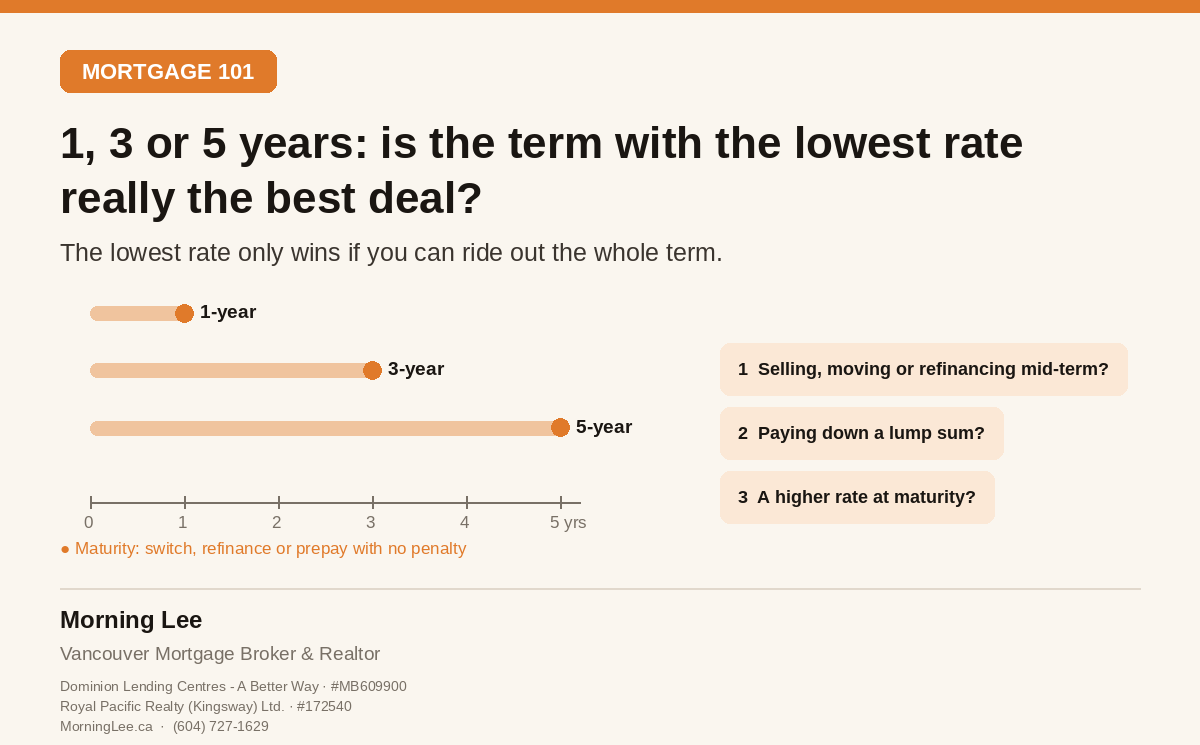
First: 1, 3 or 5 years is the term, not how long you take to pay
The term is how long your mortgage contract is in effect; the amortization period is how long it takes to pay the mortgage off completely, commonly 25 or 30 years. A 3-year term doesn't mean you're paid off in three years — it means the contract ends in three years and you sign again on the remaining balance at whatever rates are on offer then.
So picking 1, 3 or 5 years is really two choices: how long your rate is locked, and when your next maturity date falls. Maturity is the day you can switch lenders, refinance, or pay down a lump sum without a prepayment penalty.
Comparing rates alone misses two costs: the penalty for breaking early, and the rate at maturity
Selling before the term ends (without taking the mortgage with you), switching lenders, paying the mortgage off, or prepaying more than your contract allows in a year can all trigger a prepayment penalty. It's usually the higher of three months' interest or the interest rate differential (IRD), and on a fixed rate the IRD tends to grow with the time left on the term.
An example (illustrative numbers, not a quote): on a $1,000,000 mortgage at 4.2%, three months' interest is about $1,000,000 × 4.2% ÷ 4 = $10,500 — the floor of the penalty; if the IRD works out higher, you pay the IRD. Say the 3-year rate is 0.2 points below the 5-year. On $1 million that's roughly $2,000 a year, about $6,000 over three years. If you're likely to sell within three years, the 3-year term wins twice: a lower rate, and no penalty when you sell at maturity. Take the 5-year and sell in year three, and you've paid roughly $2,000 a year more for three years, plus a penalty of at least $10,500 when you sell. Even when the 5-year happens to be the cheaper rate, a few years of a small rate saving rarely covers one penalty if you sell in year three.
Short terms have a cost too: they mature sooner, and if rates are higher then, your next term costs more. On the same $1 million, every extra percentage point is roughly $10,000 a year in interest (a little less as the balance comes down). What a short term saves is paid for with uncertainty about the rate at maturity.
If something is likely to change during the term, a shorter term often comes out ahead
If you might sell, move up to a bigger home, or relocate within two or three years, line the maturity date up with that. If you'll buy again in Canada, ask whether the mortgage is portable — taking it to the new home means you don't break it, though if the new home costs less than your mortgage balance you may still pay a prepayment penalty.
If you know a large sum is coming in a particular year — stock vesting for a tech employee, a year-end bonus for an executive or someone in finance or insurance, a big commission for a salesperson, partner draws for a newly made lawyer or accountant — and you plan to use it to pay down the mortgage, check your annual prepayment privilege first. Anything above it triggers a penalty; the cleanest approach is to have the term mature that year and pay the lump sum then, penalty-free.
If you expect to pull money out of the house within a few years — a doctor, dentist, veterinarian or pharmacist buying or renovating a practice or pharmacy, an engineer or architect opening a firm — have the term mature before then, so the refinance doesn't start with a penalty. If your income structure is about to change (salary to dividends, making partner), also check how lenders will read the new income: see Making partner, switching to dividends, or opening your own practice — should you buy now, or wait?
If your income is steady and you plan to stay, a 5-year term buys certainty
For a professor, a senior public servant or senior staff at a large organization, or a pilot — steady salary, no plans to move for years — a 5-year term keeps the payment the same for five years and pushes your next brush with rates five years out. You're unlikely to break it, so the penalty is a cost you probably won't pay.
The trade-off is that 5-year rates are usually a little higher than shorter terms, and if life changes mid-term (a growing family that needs a bigger home, a job transfer), the IRD on a fixed rate can be large. So "planning to stay" should be a real plan, not just "we probably won't move."
If your budget is tight and a slightly higher payment would hurt, certainty is worth paying for. If you have room in the budget and could absorb a somewhat higher rate at maturity, the interest a shorter term saves is a real saving.
Three contract terms to pin down before you sign
First, how the penalty is calculated. Your lender must tell you how it calculates your prepayment penalty. Which two rates the IRD compares (your contract rate, a posted rate, and whether your original discount is subtracted) differs by lender, and the same situation can produce very different penalties — see Switching lenders for a lower rate: how the penalty is calculated, and when switching pays off.
Second, how much extra you can pay each year, and how: the lump-sum allowance and how much you can increase your payments vary by lender, and not every closed mortgage allows prepayments at all.
Third, portability and early renewal. A portable mortgage lets you take your rate and terms to a new home. Some lenders let you renew early, mid-term, blending your old rate with the rate for the new term (blend-and-extend); you don't pay a prepayment penalty, though there may be administrative fees.
How to compare terms side by side
Once you have quotes, don't just rank the rates. Run each term against your own plans: the interest you'll pay during the term; the penalty if you break it in the year a change is most likely (a sale, a refinance, a lump-sum paydown); and what you'll still owe at maturity, plus what a rate one point higher would cost from there. The term with the lowest total of the three is the best deal for you.
If your plans are hard to call, lean toward the offer with the friendlier penalty formula, portability and a generous prepayment privilege, even at a slightly higher rate. Send me your plans and the quotes you have, and I'll run every term through the same math.
Common questions
The 1-year rate is lowest. Can I just renew every year?
You can. The cost is re-signing at whatever the rate is each year, so if rates rise, so does yours; and if you want to switch lenders at maturity, the new lender has to approve your application. It suits people likely to sell within a year or two, or who'll pay the mortgage off once a sum of money arrives.
Can I lengthen my term mid-way without a penalty?
Sometimes. Some lenders offer early renewal (blend-and-extend): your old rate is blended with the new term's rate, there's no prepayment penalty, and there may be administrative fees. Your lender has to tell you how it calculates the new rate.
I earn a high income. Does that change how I should pick a term?
The math is the same, but three things weigh more: a large loan makes even three months' interest a big number; bonuses, dividends and stock make a lump-sum paydown more likely, so the prepayment privilege matters more; and income changes such as making partner or opening a practice can affect whether a switch or refinance at maturity gets approved.
Do variable rates come in 3- and 5-year terms too? Is the penalty the same?
Yes, variable mortgages have terms too. Breaking a variable mortgage usually costs three months' interest (check your contract), which is generally less than the IRD on a fixed rate. For choosing between the two, see Fixed vs. variable mortgage rate — how do you actually choose?
What happens if I do nothing when the term ends?
A federally regulated lender, such as a bank, must send you a renewal statement at least 21 days before the term ends; if you don't act, the mortgage may renew automatically, and the statement will say so. Starting to compare a few months ahead is the safe approach — see How early can you lock a rate before renewal?
#MorningLee #VancouverMortgageMorningLee #VancouverRealtorMorningLee
How does this land on your file?
The above is general. How it works out for you takes about ten minutes on the phone.
✆(604) 727-1629Sources
The rules, ratios, amounts and dates on this page come from the sources below; the date after each one is when it was opened and checked. Rules and fees change, so go by the latest version from each source.
- Financial Consumer Agency of Canada (FCAC): Mortgage terms and amortization (checked 2026-10-28)
- Financial Consumer Agency of Canada (FCAC): Mortgage fees: Prepayment penalties (checked 2026-10-28)
- Financial Consumer Agency of Canada (FCAC): Choosing a mortgage that is right for you (checked 2026-10-28)
- Financial Consumer Agency of Canada (FCAC): Breaking your mortgage contract (checked 2026-10-28)
- Financial Consumer Agency of Canada (FCAC): Renewing your mortgage (checked 2026-10-28)